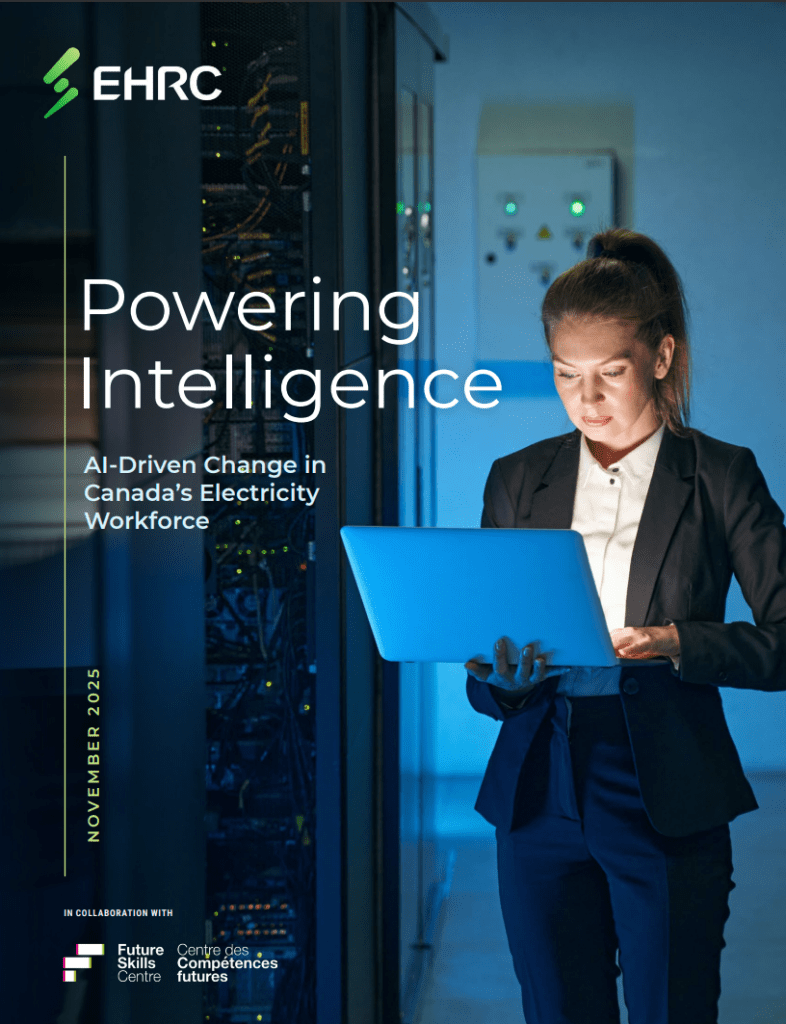
Powering Intelligence: AI-Driven Change in Canada’s Electricity Workforce

November 25, 2025
AI is reshaping Canada’s electricity sector—and the people who power it.
From predictive maintenance and outage forecasting to smart grid coordination and customer engagement, artificial intelligence is driving innovation across the industry. But progress brings responsibility: ensuring workforce readiness, ethical governance and inclusive opportunities.
What’s changing?
AI is redefining job roles, skill requirements and organizational strategies. Utilities, regulators, educators and policymakers must act now to prepare for this shift.
Why this report matters
Powering Intelligence delivers data-driven insights and practical guidance on building a resilient, equitable, and sustainable energy future—where human talent and ethical innovation lead the way.
Read the Report
EHRC research explores:
- Strategic imperatives for utilities, regulators, educators and policymakers
- The need to upskill workers, modernize infrastructure and build trust in intelligent systems
- Preparing for increasing electricity demand, particularly from AI-intensive data centres
- Coordinated planning to ensure sustainability and resilience
Developed in collaboration with the Future Skills Centre
Recommendations for Harnessing AI in Canada’s Electricity Workforce
To ensure AI strengthens resilience and equity rather than creating disruption, stakeholders must lead with a people-first approach. Lifelong learning, inclusive hiring, mental health supports and ethical governance will be critical to building trust and adaptability.
Utilities
Prepare and support the workforce for AI adoption
- Implement governance to oversee AI adoption, training and risk management.
- Conduct AI usage audits to identify tools is use and their associated tasks.
- Develop comprehensive workforce transition plans alongside AI strategies, including reskilling programs, job redesign and clear communication, to reduce uncertainty and build trust.
- Establish policies that provide workers with clear guardrails on how and when to use AI.
- Engage unions and frontline employees early in planning to ensure job quality and equitable participation.
Adopt enterprise-wide AI strategies
- Move beyond isolated pilots to integrated strategies that balance efficiency with ethical considerations, risk analysis, transparency and community trust.
Strengthen operations and resilience
- Expand AI for predictive maintenance, outage forecasting, vegetation management and disaster response to improve reliability and reduce costs.
Prioritize cybersecurity
- Invest in AI-driven monitoring and adaptive defence systems to protect critical assets and maintain public confidence.
Advance lifecycle stewardship
- Plan for AI systems lifecycle management, including model retraining, hardware upgrades and responsible decommissioning, and leverage AI for emissions monitoring and environmental compliance.