EV Charging and Local Energy Management: The Y-Split EVSE+EMS Architecture in Light of the New Chapter V
September 22, 2026
By Arnaldo Attallah, P.Eng. (retired), M.Sc.
The regulatory context
The electric vehicle fleet is growing faster than residential electrical services were ever sized to accommodate. A significant share of Québec’s housing stock was connected to the grid at a time when no one anticipated that a household would one day add a continuous load of several kilowatts just to charge a car.
For the electrician or contractor called in to assess a charger connection request, the question comes up concretely on every visit: upgrade the service’s amperage, or intelligently manage the existing load? The second option — cheaper for the customer and less demanding on the grid — requires equipment capable of reliably limiting charging power at all times.
It is this context that the Government of Québec set out to address with Decree 236-2026 (Gazette officielle du Québec, Part 2, March 11, 2026, 158th year, No. 10; decree dated February 25, 2026), which amends Chapter V – Electricity of the Québec Construction Code. The new text, in force since March 26, 2026, introduces a precise requirement for any electric vehicle charging equipment (EVSE — ARVÉ, the official term used in the decree) installed on a service with limited capacity: overload protection must be provided by a « local controller ».
This requirement is worth pausing on, because it is not merely a matter of regulatory vocabulary: it defines, implicitly, what a manufacturer must be able to demonstrate for a device to be recognized as compliant.
EMS or DSDC: two paths, one common requirement
Article 8-106 (paragraphs 10 to 12) and Article 8-500 of Chapter V lay out two distinct approaches for meeting this requirement:
- the EMS (SGÉVÉ) (Energy Management System for electric vehicles): the Code defines it as any means of controlling power to the EVSE’s loads through the process of connecting, disconnecting, increasing, or reducing the electrical supply to the loads — a deliberately broad definition, covering both on/off control and continuous modulation. The EMS must also monitor the service entrance, feeders, and branch circuits, and control loads in accordance with Article 8-500; the demand load then used is whichever value it authorizes at most;
- the DSDC (load monitoring and shedding device — dispositif de surveillance et de délestage de charges): a type of load controller that taps the feeder current upstream of a panel to create a new branch circuit feeding the EVSE, monitors that current, and interrupts or restores power to the connected EVSE once that current reaches a preset threshold. For the load-calculation exemption provided under paragraph 12 of Article 8-106, that threshold corresponds to whichever is lower: the calculated load of the dwelling (excluding the EVSE) or 80% of the feeder circuit’s rated current.
Both paths are recognized by the Code. A DSDC is, in effect, a specifically defined special case of the broader EMS principle: it is designed specifically for situations where the EVSE is fed by tapping the feeder upstream of a dwelling’s panel. In both cases, the underlying requirement remains the same, and it is worth dwelling on: the management and protection function must remain operational locally as long as the installation is powered, without depending on an Internet connection.
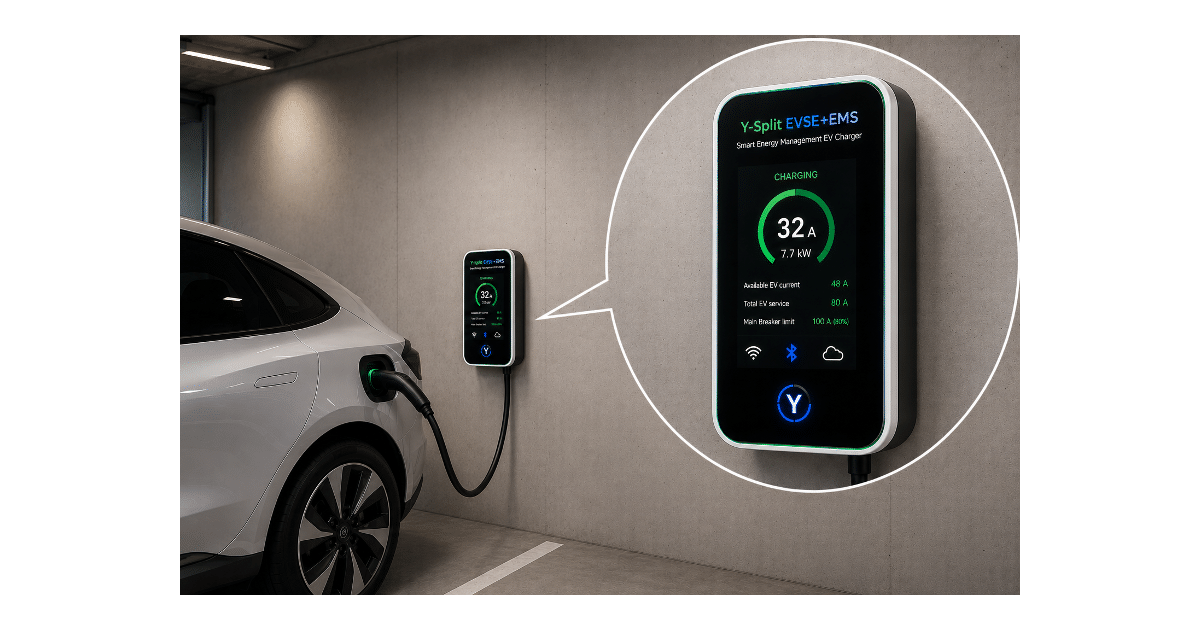
One point deserves clarification: the Code does not require an EMS to modulate current continuously. Its definition covers both on/off control (connect/disconnect) and progressive modulation (increase/decrease) — a device that cuts and restores power at a fixed threshold can therefore, on that basis, be a fully compliant EMS. In the Y-Split EVSE+EMS architecture, the EVSE and EMS are integrated within a single device, and the technical choice made is one of fine, closed-loop proportional regulation, modulating the vehicle’s current across 87 discrete steps via the Pilot PWM signal generated by the EVSE for the EV to obey. This is therefore a more refined implementation choice than simple threshold control — one that allows charging to continue at reduced power rather than being interrupted — and not a requirement the Code imposes on every EMS. To the author’s knowledge, and based on the prior-art review conducted in the technical declaration, this combination of functions — proportional regulation applied to an EMS integrated directly into the EVSE — does not appear to have been identified in any prior commercial application.
What the Code does not require
It is worth stating explicitly, since this is probably the most useful takeaway of this article for an electrician, contractor, or utility engineer evaluating a device on the market: Chapter V defines a function to be fulfilled, not a technology to fulfill it. Concretely, the Code does not require:
- a minimum number of regulation steps (the 87 steps are a Y-Split design choice, not a regulatory requirement);
- proportional regulation rather than threshold (on/off) control;
- independent measurement of charging current by a dedicated current transformer;
- a particular architecture combining the EVSE and the EMS in a single enclosure;
- integrated charging equipment and management system rather than units sold separately.
The Y-Split EVSE+EMS, described in the sections that follow, is one way of fulfilling the function required by the Code — one among others that a manufacturer could just as legitimately design.
The essential functions of proportional charging-current management
In an architecture that chooses proportional modulation over threshold control — such as the Y-Split EVSE+EMS — a charging-current management system typically performs the following specific functions:
- Real-time measurement of the total current drawn by the dwelling, to know at all times the residual capacity available for vehicle charging.
- Communication of the current limit to the vehicle via the Pilot signal (SAE J1772 standard), whose duty cycle (PWM modulation) tells the vehicle’s onboard charger the maximum current it is allowed to draw. It is the vehicle itself that complies with this limit; the charging station does not need to abruptly cut power mid-charge.
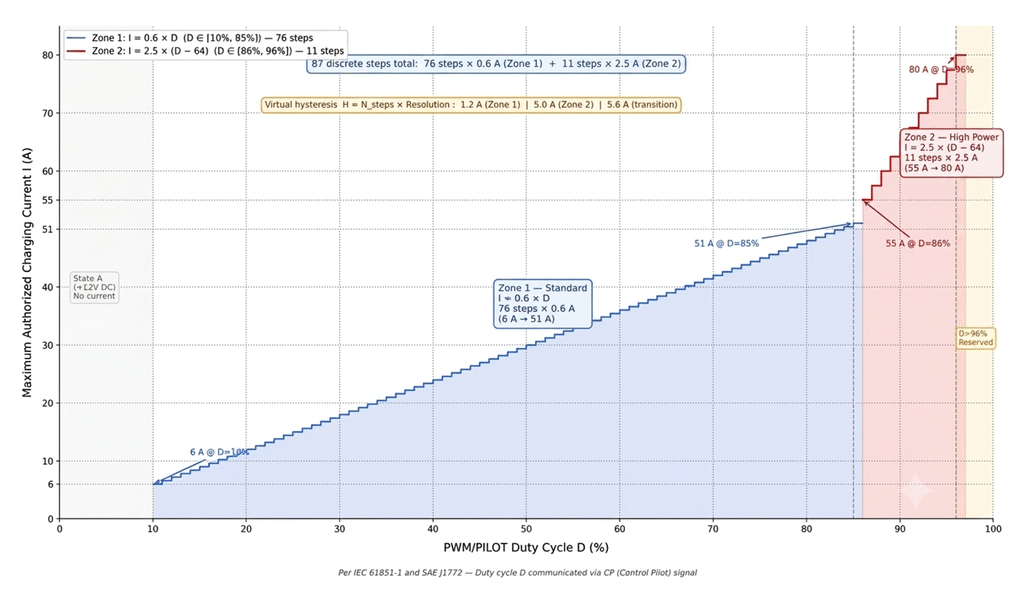
- Proportional adjustment in discrete steps, fine enough to avoid abrupt jumps rather than a simple binary choice between full power and shutdown — 87 steps in total for the Y-Split EVSE+EMS architecture: 76 steps of 0.6 A (from 6 to 51 A) for the standard operating range, and 11 steps of 2.5 A (from 55 to 80 A) for the high-power range.
- Real-time response to variations in household load (stove, dryer, heating) that change — upward or downward — the residual current available for the vehicle.
- Fallback behavior on a confirmed fault: the system can suspend charging while keeping the EVSE powered, lock its operation until a manual intervention, and send timestamped alerts to the responsible parties (master electrician, building management) — ensuring that main panel protection remains assured even if a subsystem stops responding normally.
It is this whole set of functions, executed locally, that allows such an EMS to satisfy both the spirit and the letter of the « local controller » criterion adopted by Chapter V — just as a DSDC or a threshold-based EMS do, through a simpler mechanism.
Why « local » became a safety requirement
This point is not incidental. Article 8-500 requires that if communication between the current transformer and the charging station is interrupted, the system must automatically reduce the load to a safe minimum, or cut it off. A system whose power-management decision depended exclusively on a cloud server could not perform this function autonomously in the event of a lost network connection. That said, the presence of Wi-Fi or Internet connectivity is not in itself incompatible with local operation: it can be used for telemetry, alerts, or updates, provided the safety function itself does not depend on it. Chapter V thus establishes a requirement for local control of load management in the situations it targets; it does not prescribe any particular technology for achieving this. The Y-Split EVSE+EMS architecture, presented further on, is one possible way of technically implementing this function — one among others a manufacturer could design.
It is with this in mind that the Y-Split EVSE+EMS architecture was developed — a proportional regulation architecture using pulse-width modulation on the Pilot signal (PWM/PILOT), capable of modulating the current delivered to the charging station across 87 discrete steps. The principle was illustrated through closed-loop simulations at 60 A, 100 A, and 200 A, documented in bilingual demonstration videos — design simulations, not real-world experimental tests.
Concretely, two current transformers (CT1 and CT2) separately measure the current on each of the two phases feeding the dwelling’s loads, while a third current transformer (CT3), placed inside the EVSE downstream of its own contactor, independently measures the current actually delivered to the vehicle. For a North American split-phase service, the total current to be respected on each phase is expressed as the sum of the measured household current and the charging current measured by CT3:
| I total, L1 = | I L1 | + I EVSE I total, L2 = | I L2 | + I EVSE max( I total, L1 , I total, L2 ) ≤ 0.80 × I main breaker |
In the application example presented here, the protection threshold is set at 80% of the main breaker’s rating, in keeping with the continuous-load limit adopted in the architecture. The precise implementation parameters must, however, be determined and validated according to the applicable Code, the relevant standards, and the certified product.
Rather than a fixed limit, the system computes an adaptive threshold — denoted S*(t) in the technical declaration — that varies over time between a minimum and a maximum value depending on the measured household load, with hysteresis mechanisms designed to prevent oscillation, both in adjusting the adaptive threshold and in transitioning between regulation steps.
The central point, from a regulatory standpoint, is this: the regulation decision is made locally, at the dwelling level, and the management and protection function remains operational locally as long as the installation is powered — without depending on an Internet connection. This is precisely the « local controller » criterion as defined by Chapter V.
It is important to clarify the exact nature of what is being proposed: the Y-Split EVSE+EMS is an architecture, not a finished product. Joint CSA/ANSI C22.2 No. 343:25 certification (charging station + EMS), which applies to a complete commercial product, is the responsibility of whichever manufacturer chooses to build such a product from this architecture — it has not been undertaken by the author.
This architecture is part of work begun as early as 2016. Its complete technical declaration (version 1.2, bilingual French-English, 101 pages) was deposited on Zenodo, under Creative Commons CC0 1.0 license, on August 26, 2026, under the permanent reference DOI 10.5281/zenodo.22106830 — a concept DOI that always points to the most recent version of the document (currently zenodo.org/records/21482721) — along with an abridged version under the permanent reference DOI 10.5281/zenodo.22102739 (currently zenodo.org/records/21543053). An earlier preliminary deposit, made on July 21-22, 2026 (version DOI 10.5281/zenodo.21482722), establishes the anteriority of the publication.
For the sake of accuracy, it should be noted that the Chapter V update came into force on March 26, 2026 — four months before the declaration was published. The correspondence between this architecture’s design principle and the « local controller » definition adopted by the Code is therefore a convergence, not an anteriority that influenced the regulatory text.
How the architecture actually works
In practice, the operating principle breaks down into six steps, all executed inside a single enclosure integrating the EVSE and the EMS:
- Current measurement via three transformers — CT1 and CT2 separately measure the current on the two phases feeding the dwelling’s loads, while CT3, placed downstream of the EVSE’s internal contactor, independently measures the current actually delivered to the vehicle.
- Adaptive threshold calculation — denoted S*(t) in the technical declaration — rather than a fixed limit, a closed-loop algorithm continuously recalculates this threshold, bounded between a minimum and a maximum, based on the measured household load, with a hysteresis band to prevent rapid oscillation of the setpoint. Only the ceiling of this threshold (80% of the main breaker’s rating) is a requirement of the Canadian Electrical Code (Article 8-104(5), continuous-load rule); the floor is an additional safety margin specific to this architecture.
- Communication to the vehicle — this limit is transmitted to the vehicle by modulating the Pilot signal (PWM), across the 87 steps illustrated in Fig. 4 above; the vehicle itself then adjusts its own charging current accordingly.
- Simplified configuration — commissioning requires only a single input, entered via Bluetooth: the main breaker’s amperage rating. The protection decision itself — current measurement, threshold calculation, and Pilot signal generation — runs continuously and locally, independent of any active Bluetooth connection; Bluetooth is used only for initial setup and for the manual unlock described below. No DIP switches, no additional configuration.
- Fully local operation — measurement, calculation, and Pilot signal generation all take place within the same device, without passing through a remote server; protection therefore remains active even during an Internet outage.
- Fallback on a confirmed fault — as soon as a fault is confirmed (for example, the vehicle fails to execute a commanded current reduction), charging is suspended and does not resume automatically: the system locks its operation, cuts power to the vehicle, and sends two timestamped alert emails — one to the master electrician responsible for the installation, the other to building management. Only the master electrician can then unlock the system, manually, via the local Bluetooth interface.
It is this complete loop — measurement, calculation, communication — closed locally without any network intermediary, that allows the architecture to meet the « local controller » criterion, while offering a fineness of regulation (87 steps) that goes well beyond what the Code requires at minimum.
A precedent: the first home energy manager
This is not the first time the author has developed a local load-management controller of this kind in Québec. Between 1976 and 1980, the TH-100 — invented by the author and designed for Thermolec as part of Hydro-Québec’s first dual-energy load-shedding program — already regulated the current drawn by an electric heating coil grafted onto an existing oil furnace: a purely electronic, local regulation with no dependency whatsoever on an external communication link. The circuit relied on two current transformers and 4-bit logic offering 16 load-shedding levels, driving four contactors. Two demonstrations of this circuit, still functional, were filmed in 2026 and incorporated into the Y-Split EVSE+EMS technical declaration as a historical benchmark of the principle.
The TH-100 can thus be seen as a direct ancestor of today’s energy managers: the same principle of local measurement and autonomous decision-making, with no external communication link, connects the TH-100 of the 1970s to today’s EMS units, and reappears — pushed to its finest form — in the 87-step proportional regulation of the Y-Split EVSE+EMS.
Video and documentation resources
Zenodo occasionally experiences temporary access slowdowns (high traffic). If a page does not load right away, please try again in a few minutes or write to the author (aattallah@gmail.com) to receive the PDF files.
100 A Simulation — the English-language demonstration video of proportional regulation at 100 A:
The choice of open publication
An international patent application (PCT) had been fully prepared for this architecture. The decision was ultimately made not to file that application and instead to favor a documented public disclosure: the architecture was published into the public domain, under a CC0 license, rather than pursuing commercial exclusivity. The goal is to make this local-regulation principle available to any manufacturer wishing to draw on it to design a compliant charging station, free of any royalty or license to negotiate.
What this means in practice for electricians, contractors, and utilities
For the electrician or contractor, the most important advantage of an architecture like the Y-Split EVSE+EMS lies in how simple it is to commission. Only a single value needs to be entered, via the Bluetooth interface: the main breaker’s amperage rating. Everything else — measuring the residual load, calculating the current limit, modulating the Pilot signal — then configures itself automatically, with no DIP switches to set.
In the field, the Chapter V requirement also has a direct practical consequence: when choosing and installing an EVSE on a limited-capacity service, it becomes necessary to check, in the manufacturer’s documentation, whether the protection function (EMS or DSDC) is executed locally by the device itself, or depends on a remote service. A device that switches to a safe « fail-safe » mode when it loses its network connection meets a safety objective, but that does not necessarily establish that the power-management decision itself is made locally on an ongoing basis — which is the heart of the Chapter V requirement.
Concretely, a few questions can guide this verification with a manufacturer or distributor:
- Is the current limit applied to the charging station calculated by a microcontroller located inside the dwelling, or by a remote server queried at regular intervals?
- What exactly happens in the seconds following a loss of Internet connection: does the charging station hold its last setpoint, fall back to a fixed safety limit, or simply stop reacting to changes in the dwelling’s load?
- Does the device regulate current continuously and proportionally, or does it operate by cutting off and resuming at a fixed threshold? Both approaches can be fully compliant with Chapter V, but they do not offer the same user experience during a consumption peak.
These are the same kind of questions an electrician or contractor already asks, by reflex, about any protective device: not « does it look smart? » but « what is making the decision, and where? »
In conclusion
The Chapter V update confirms a simple but foundational direction: protecting a limited-capacity residential electrical service cannot depend on an upstream service outside the dwelling’s control. Whether one opts for a proportional EMS or a threshold-based DSDC, the management and protection function must remain operational locally as long as the installation is powered. The Y-Split EVSE+EMS architecture, freely published, is offered as a concrete illustration — one among other possible ones — of how this principle can be implemented.
References
- Decree 236-2026, Gazette officielle du Québec, Part 2, March 11, 2026, 158th year, No. 10 (decree dated February 25, 2026).
- Québec Construction Code, Chapter V – Electricity, Articles 8-106 and 8-500, in force since March 26, 2026.
- Attallah, A. Y-Split EVSE+EMS (ARVÉ+SGÉVÉ) – Bilingual Declaration, version 1.2, Zenodo, August 26, 2026. Concept DOI (most recent version): 10.5281/zenodo.22106830. zenodo.org/records/21482721
- Attallah, A. Bilingual Announcement of the Invention, version 1.2, Zenodo, August 25, 2026. Concept DOI (most recent version): 10.5281/zenodo.22102739. zenodo.org/records/21543053
- Attallah, A. Preliminary Deposit (anteriority), Zenodo, July 21-22, 2026. Version DOI: 10.5281/zenodo.21482722
- Demonstration videos (TH-100 and Y-Split EVSE+EMS simulations at 60/100/200 A), YouTube channel @aattallah.