SaskPower & First Nations Power Authority Announce 100 MW Mino Giizis Solar Energy Facility
January 15, 2026
100 MW Mino Giizis facility will be operational by 2028
The Saskatchewan Power Corporation (SaskPower) and First Nations Power Authority (FNPA) have announced Neoen as the winning bid in their joint competitive request for proposals for a 100 MW solar energy project.
The power purchase agreement (PPA) covers 100 per cent of the output from the 157 MWp / 100 MWac Mino Giizis Solar Energy Facility, located in the Rural Municipality of Lajord No. 128 in south central Saskatchewan.
Developed by Neoen, the asset will be co-owned under a 50 per cent equity partnership with the Anishinabek Power Alliance (APA). The PPA with will supply enough clean electricity to the province’s grid to power approximately 30,000 homes every year, supporting the SaskPower’s commitment to achieve a net-zero greenhouse gas emissions power system by 2050.
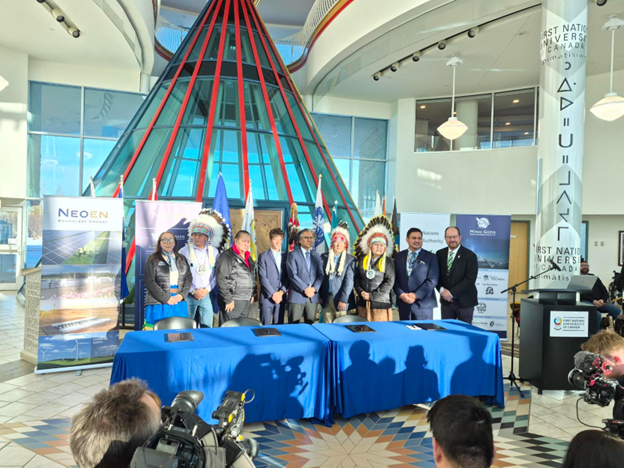
APA is a partnership of four of the Treaty 4 Nations: Zagime Anishinabek Nation, Kinistin Saulteaux First Nation, Cote First Nation, and The Key First Nation with political participation from the Yorkton Tribal Council. Mino Giizis means “good sun” in Ojibwe language. Neoen will be the long-term owner and operator of the solar facility. This collaboration will deliver significant benefits to First Nations communities and the regional economy, with an estimated workforce of up to 350 construction workers anticipated during the peak construction phase.
Mino Giizis Solar Energy Facility will supply SaskPower with clean electricity for 25 years from commissioning, supporting its commitment to achieve a net-zero greenhouse gas (GHG) emissions power system by 2050 or earlier. The facility will also help meet growing demand for renewable energy solutions from commercial and industrial businesses. Through collaboration with FNPA, the project will deliver robust economic and social benefits for First Nations communities. Expected to be operational in 2028, the facility will generate approximately 228,000 MWh of emissions-free electricity annually– enough to power approximately 30,000 homes.
This announcement underscores Neoen’s ambition to become a leading player in Canada and to make a significant contribution to the country’s energy transition. Neoen’s Canadian portfolio includes the 93 MWp Fox Coulée solar farm in Starland County, Alberta, which began commercial operations in June 2024. Since establishing its Canadian office in Calgary in 2022, Neoen has expanded to Toronto and is actively developing a diverse portfolio of solar, storage, and wind projects across Alberta, Saskatchewan, and Ontario.
The Canadian Renewable Energy Association (CanREA) said in a press release that they welcome the news and are pleased that its member company Neoen will develop the new solar farm.
“Saskatchewan is showing what can be achieved when utilities and Indigenous leadership work together to build our renewable energy future. This solar procurement partnership between SaskPower and First Nations Power Authority demonstrates economic reconciliation in action, to deliver long-term benefits for communities, ratepayers and the electricity system,” said Vittoria Bellissimo, CanREA’s President and CEO.
This announcement represents the last tranche of existing major renewable energy procurements in Saskatchewan and brings the total installed capacity of renewables in the province to just under 1,000 MW. Additional calls for power are expected in the coming years, as SaskPower committed in 2022 to procure a total of 3,000 MW of wind and solar by 2035.
“We have been working hard alongside independent power producers and Indigenous communities and businesses as they navigate renewable energy procurement processes in Saskatchewan, and I’m very happy to see this approach get its day in the sun,” said CanREA’s Director of Policy for Saskatchewan and Manitoba, and Director of Indigenous Engagement, Kelly Hall, who was on hand for the announcement in Regina. “We look forward to continuing to support developers and Indigenous partners through our advocacy in the province.”