IESO’s 2026 Annual Planning Outlook Shows Long-Term Energy Demand Continues to Rise
April 7, 2026
The IESO’s yearly forecast of electricity demand, reliability assessments, and identified capacity and energy needs is now available.
The Annual Planning Outlook helps guide future actions and build a foundation for decision-making by identifying system needs and planned actions that are needed to ensure the reliability, affordability, and sustainability of Ontario’s electricity system — and to support economic growth.
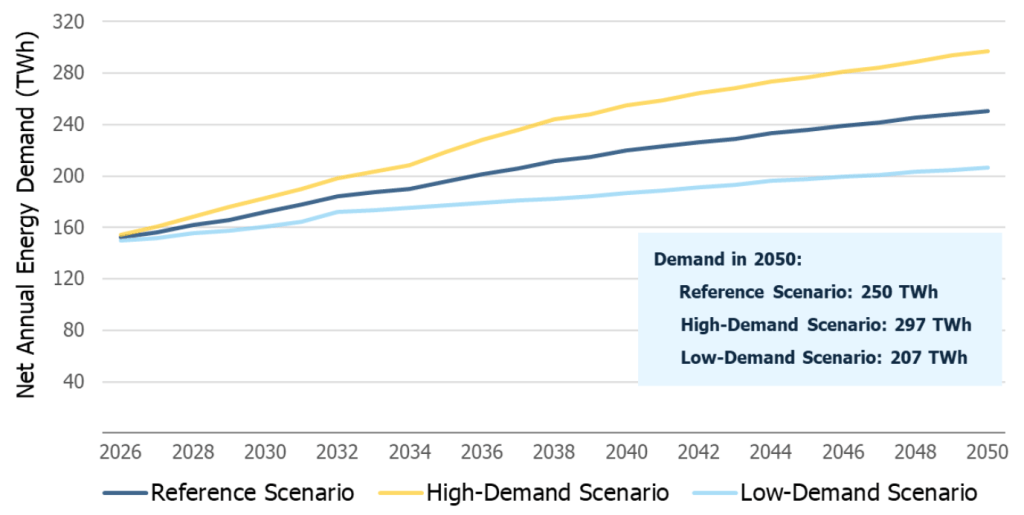
Ontario electricity demand is forecast to grow 65 per cent, in line with recent forecasts, driven by economic development, population growth and electrification. Strong growth potential persists despite geopolitical disruption. High- and low-growth scenarios have been modelled to provide greater insight into how key variables, like electric vehicle adoption, could alter the trajectory. 2026 Annual Planning Outlook in 5 Graphs and a Map
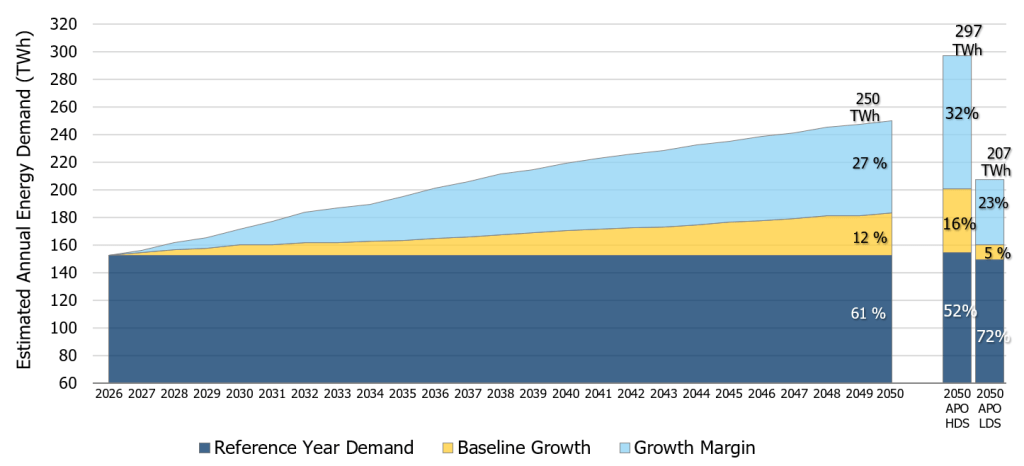
What’s new for 2026 is the development of high- and low-demand scenarios, in addition to the reference demand forecast scenario, to better illustrate and prepare for potential future system conditions. The IESO has also introduced a growth margin that groups together the areas of increasing demand that are particularly variable to allow for improved tracking and monitoring of the key drivers that could impact year-over-year planning.
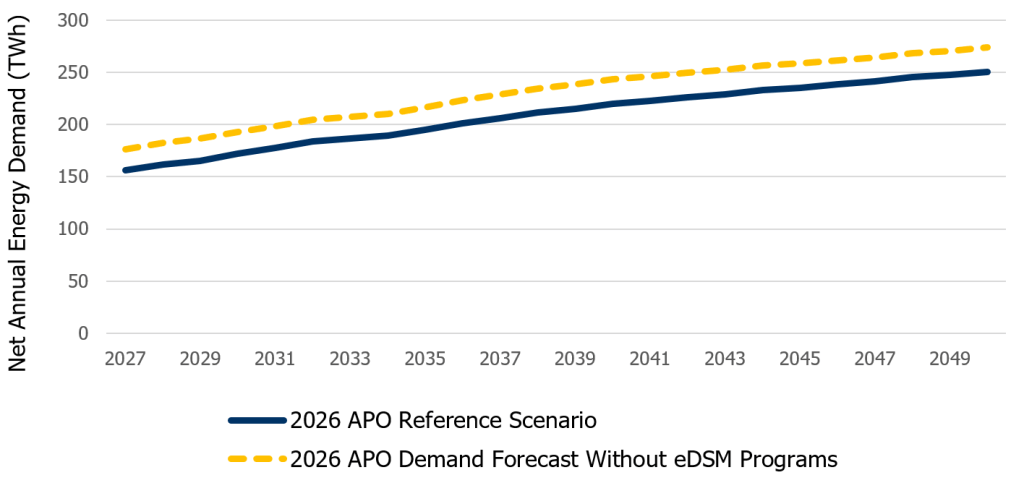
While the 2026 forecast shows some short-term demand impacts — the long-term trend of significant growth is consistent with past outlooks and shows Ontario is poised to continue growing through the 2030s and beyond. This factors in a bigger impact from energy efficiency, compared to previous outlooks, due to new and expanded programming.
In addition to adding high- and low-demand scenarios, the IESO is introducing a new growth margin that groups together areas of demand growth that are particularly variable, like electric vehicles and data centres. Separating these variables from more stable factors influencing demand growth, like population growth, allows for improved tracking and monitoring of key drivers that impact year-over-year planning. Source:2026 Annual Planning Outlook in 5 Graphs and a Map
The short-term uncertainty in the 2026 demand forecast reinforces the value of the IESO’s iterative approach to planning and procurements, ensuring the IESO, electricity sector, and the province can be agile and adaptable as bold investments in infrastructure and energy efficiency are made to secure Ontario’s energy future.
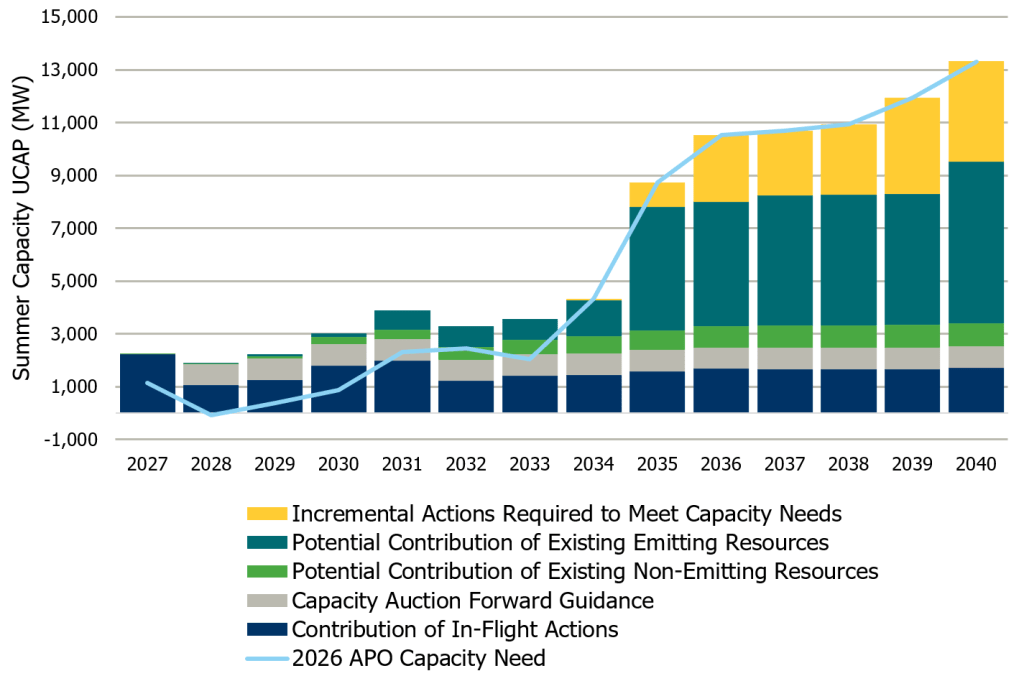
New and expanded energy efficiency programs are reflected in this year’s forecast and will contribute to an overall demand reduction of 8 per cent by 2050, the equivalent to the annual power needs of Toronto today. One of our lowest-cost resources, energy efficiency benefits the grid while helping families and businesses reduce costs. Source: 2026 Annual Planning Outlook in 5 Graphs and a Map Thousands of megawatts of battery storage and natural gas-fired generation have been competitively procured in recent years, meaning Ontario will not have significant incremental capacity needs until the mid-2030s. Most capacity needs that emerge earlier will be met by reacquiring existing supply at lower prices, leveraging energy efficiency programs and the annual Capacity Auction. While Ontario’s current position is strong, continued investment is needed, with several procurements planned for the coming years. Source:2026 Annual Planning Outlook in 5 Graphs and a Map There are a variety of options to help meet energy needs, with an 8 TWh need emerging in 2032. On-time delivery of new and refurbished nuclear can address a significant portion of energy needs in the early-2030s, while resources like wind and solar are expected to be procured for the first time in 10 years through the second Long-Term RFP. Gas generation is modelled to operate at levels far below its capability and can provide more energy as necessary. Source:2026 Annual Planning Outlook in 5 Graphs and a Map More than 1,800 kilometres of transmission projects are planned or under development across the province, and several new transmission lines are expected to be announced this year. Competitive transmission selection is being introduced in Ontario for the first time to drive down costs, beginning with the first-in-Ontario underwater line that will support Toronto’s growing electricity needs. (Note: Dotted lines indicate conceptual locations for anticipated transmission projects and not final routes.) Source: 2026 Annual Planning Outlook in 5 Graphs and a Map
For more, including key takeaways, additional data tables, and accompanying modules, visit www.ieso.ca/APO.
November 12, 2024 By Keith Sones, seasoned utility industry executive Most of the articles I’ve written have been based on personal experiences, many of them occurring decades ago, which eventually translate into helpful life lessons. The years allow the events to marinate in a savoury stew of time and reflection, clarity never coming immediately, or even…
Launched in 2019, the Zero Emission Vehicle Infrastructure Program (ZEVIP) is a program that addresses a key barrier to the adoption of zero-emission vehicles…
February 9, 2026 OPG has announced a significant milestone with the completion of construction on the refurbishment of the Darlington Unit 4 nuclear reactor. The unit is now complete and will be returning to service four months ahead of schedule, the overall refurbishment project coming in $150 million under budget. Originally expected to return to…
February 9, 2026 NERC’s 2025 Long-Term Reliability Assessment (LTRA) and infographic spotlight intensifying resource adequacy risks throughout the North American bulk power system (BPS) over the next 10 years. Summer peak demand is forecast to grow by 224 GW, a more than 69% increase over the 2024 LTRA forecast with new data centers for artificial intelligence and the digital…
New clean electricity generation is needed beginning in 2030 to keep pace with Ontario’s growing economy and advance grid decarbonization, according to a new report from the Independent Electricity System Operator (IESO). This new supply will help meet overall energy needs and support the process of eliminating emissions from the electricity system.
August 27, 2025 Clean energy projects cancelled since the start of Alberta’s renewables moratorium could have generated more than Alberta’s average total power demand (109 per cent), according to new analysis from the Pembina Institute. Since October 2023, projects amounting to almost 11 gigawatts (GW) of wind, solar and energy storage have been withdrawn from the…