Canada’s Changing Climate Report 2026
September 9, 2026
This second edition of Canada’s Changing Climate Report (CCCR2026) is a scientific assessment of past and future changes in Canada’s climate.
It provides an update to the first edition of Canada’s Changing Climate Report (CCCR2019).
This report contributes to the Canada in a Changing Climate: National Assessment Process, the national assessment of how and why Canada’s climate is changing; the impacts of these changes on our communities, health, environment, and economy; and how we are adapting across the country.
Summary
This second edition of Canada’s Changing Climate Report (CCCR2026) is a scientific assessment of past and future changes in Canada’s climate. It provides an update to the first edition of Canada’s Changing Climate Report (CCCR2019) (Bush and Lemmen, 2019), drawing on new science published in peer-reviewed scientific literature. It is similar in scope to the first edition, focusing on changes in the physical climate system. Assessing the impacts of climate change in Canada is outside the scope of this report. The report was primarily authored by experts from the Canadian climate science community, who were selected following an open call for authors. Formally, this report delivers on commitments in the Government of Canada Adaptation Action Plan to develop regular Canada-wide climate science assessments to inform decision-making on adaptation. Chapter 1 of the report provides more detail about the assessment process, including how this report contributes to the Canada in a Changing Climate: National Assessment Process.
What’s new
This report has new features compared to the 2019 edition (Figure RS.1). These new features are intended to cover more topics of interest, to provide both overview material and detailed technical material to help serve the needs of a variety of audiences, and to provide a specific chapter to help bridge the gap for decision-makers between using the information in this assessment report and finding more tailored information to support local adaptation planning and activities. A new feature for CCCR2026 is the inclusion of First Nations, Inuit, and Métis place-based case stories that document Indigenous science, observations, and perspectives on the implications of climate change (section RS.3, Box RS.1). These case stories provide complementary knowledge to the lines of evidence drawn from Western science that are formally assessed in this report. Chapter 1, section 1.3.5, explains some of the opportunities and challenges encountered during the CCCR2026 assessment process when engaging ethically and equitably with Indigenous experts and Indigenous science.
CCCR2026 introduces some new features to expand the topics covered and improve accessibility of the report to different audiences.
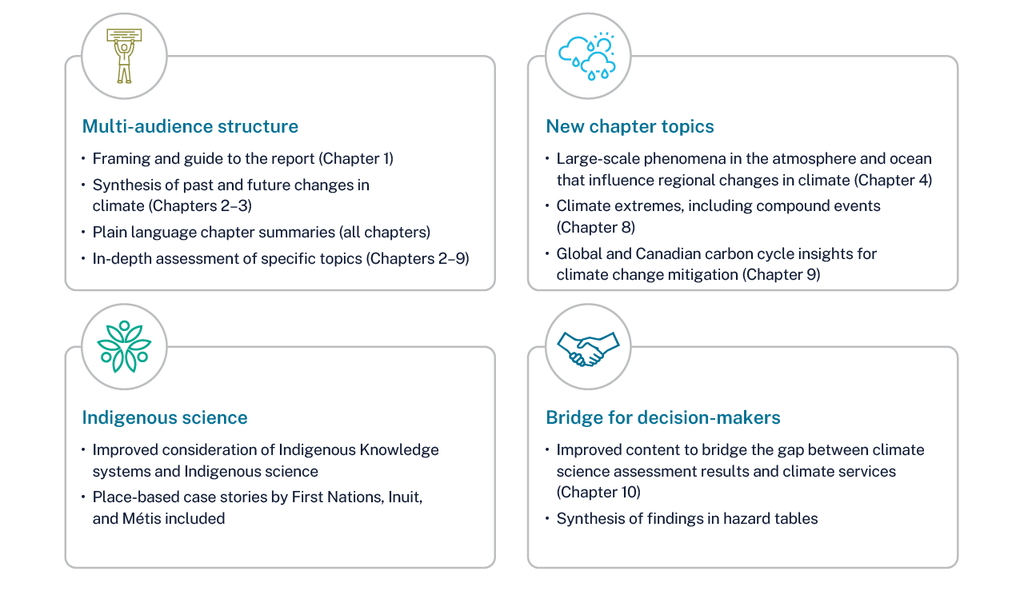
Figure: The second edition of Canada’s Changing Climate Report (CCCR2026) includes a multi-layered structure that improves reader navigability for a variety of audiences. New chapters provide additional or expanded coverage of topics in climate science. Other new features are the inclusion of case stories from First Nations, Inuit, and Métis authors, and guidance on accessing and using tailored climate data for adaptation. Source: Chapter 1, Figure 1.4.
In addition to having new features, this report builds on important developments in climate science and on an increase in the number of scientific studies that made it possible to assess new topics. CCCR2026:
- uses enhanced observational datasets to provide a much more comprehensive assessment of past changes in Canada’s climate and of the consistency of these changes with human influence (multiple chapters)
- assesses human-induced warming in Canada since the mid-19th century as well as since the mid-20th century. (Chapter 2)
- draws on a stronger evidence base for the formal attribution of changes in some climate variables to human influence (multiple chapters)
- includes decadal predictions of climate change to help characterize near-term changes in temperature across Canada (Chapter 3)
- assesses long-term changes in climate in Canada for a range of policy-relevant greenhouse gas emissions scenarios and, for some variables, on the basis of future global warming levels (multiple chapters)
- narrows the range of long-term projected warming under a given emissions scenario, by constraining those projections with observations (Chapter 3)
- includes an assessment of past and future changes in large-scale atmosphere and ocean circulation patterns that influence regional climate variability in Canada (Chapter 4)
- expands the assessment of climate-related changes in freshwater availability across Canada to include the atmospheric component of the water cycle (Chapter 5)
- introduces landscape change as a new indicator of permafrost thaw (Chapter 6)
- includes an assessment of marine heatwaves (Chapter 7)
- includes an assessment of multiple types of extreme precipitation and of compound extreme events (Chapter 8)
- includes an assessment of trends in Canadian land and ocean carbon sources and sinks (Chapter 9)
- identifies key knowledge gaps and emerging issues (chapters 2 to 8)
Findings of this report
The overarching conclusions of CCCR2026 are captured in a set of Headline statements that can be found below. These Headline statements tell a concise story about past and future changes in climate in Canada based on the findings of this report and encourage readers to delve into the report to learn more. Detailed findings of the report are provided by the chapter key messages, which can be found in the Annex to this summary and in the main chapters of this report.
An important part of a scientific assessment is determining and communicating the degree of uncertainty associated with assessment findings. In both CCCR2019 and this report, the authors adopted the calibrated uncertainty languageFootnote1 set out by the Intergovernmental Panel on Climate Change (IPCC) for use in its Fifth Assessment Report and Sixth Assessment Report (Mastrandrea et al., 2010). Unless otherwise stated, there is at least high confidence in the findings in this summary. High confidence findings are substantiated by a robust evidence base and strong agreement across independent scientific studies and multiple lines of evidence.
For readability, the Headline statements do not include confidence terms. Round brackets at the end of the Headline statements contain references to the main sections of the report that provide supporting evidence for these statements, based on peer-reviewed scientific literature. For example, “2.2” refers to Chapter 2, section 2.2. Also for readability, the Headline statements provide central best estimates for past and future changes. Uncertainty ranges are included in the chapter key messages. In this report summary, additional context, findings, and visualizations of key findings are provided below each Headline statement, drawing primarily from the chapter key messages.
Warming and warming-driven changes in climate
Changes in climate are occurring across Canada against a backdrop of global climate change. The IPCC concluded that human activities, principally through emissions of greenhouse gases, have unequivocally caused global warming (IPCC, 2021). The IPCC also concluded that limiting human-caused global warming requires net-zero carbon dioxide (CO2) emissions, and that even after net-zero CO2 emissions are reached and sustained, global temperature will remain elevated for millennia. These conclusions underscore the irreversible nature of human-caused climate change.
The pace and scale of changes in climate that people in Canada will need to adapt to, especially in the second half of the century, when the current generation of children will be adults, will be determined by how global greenhouse gas emissions evolve. Since risks and adverse impacts from climate change escalate with every increment of global warming (IPCC, 2022), consequences of high emissions scenarios are much more severe than those of low emissions scenarios for those living in Canada and elsewhere.
Canada has warmed over the past 75 years due to emissions of greenhouse gases from human activities. Over this period Canada has warmed by 2.0°C and Canada’s North has warmed by 2.6°C. (2.2, 2.4, 4.2)
The coverage of temperature observations across Canada becomes extensive enough to confidently estimate annual temperature changes in Canada from 1948 onwards. The best estimate of warming in Canada over the full observation record from 1948 to 2023 is 2.0°C, while that for Canada’s NorthFootnote2 (Yukon, the Northwest Territories, and Nunavut) is 2.6°C. Annual average temperatures have risen almost everywhere in Canada. Canada’s annual average temperature exceeded the 1961 to 1990 average in 30 of the 33 years after 1990. Canada has warmed in all regions and seasons, but warming has been greater in winter and fall than in spring and summer. Drawing on new and stronger evidence, there is higher confidence in the attribution of warming in Canada to human influence than the assessment made in CCCR2019.
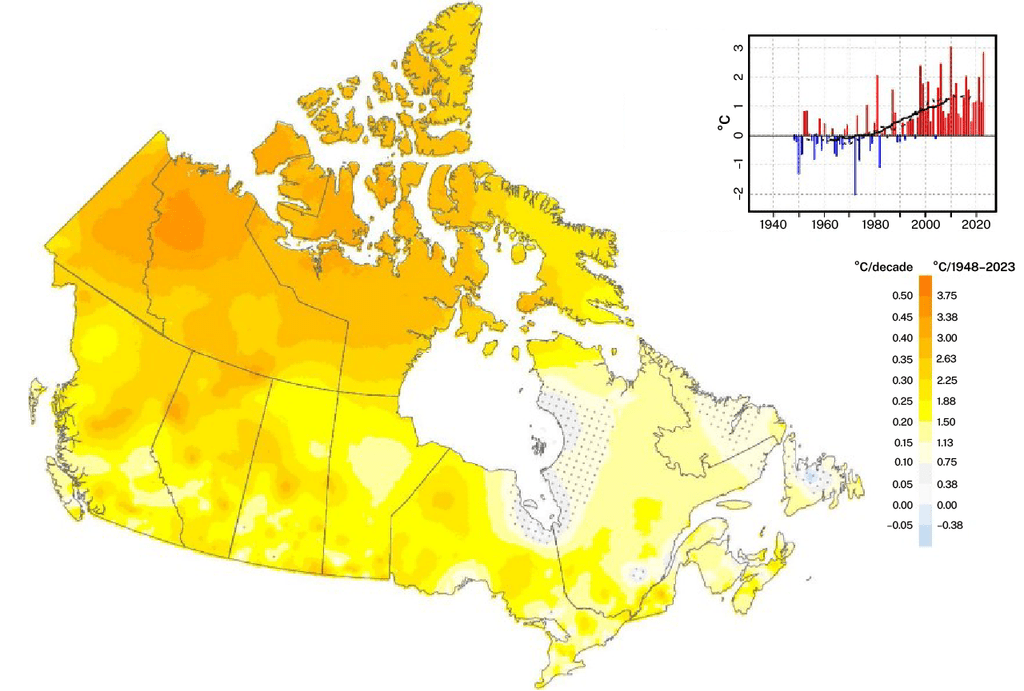
Figure: Map and time series of observed changes in annual average daily mean temperatures across Canada over the period from 1948 to 2023. Areas without dots are areas where the trends are statistically significant at the 5% level (meaning there is a <= 5% chance of concluding that an effect or trend exists when it does not.) Source: Chapter 2, figures 2.6 and 2.7.
Canada has warmed rapidly over the past 50 years, consistent with rapid global warming.
Since 1970, Canada has warmed nearly twice as fast as the global average, and the Canadian Arctic has warmed three times as fast as the global average. (2.2, 2.4, 4.2)
Most of the warming since 1948 has happened since 1970, both in Canada and globally. Over this period, warming has happened more rapidly in Canada than in most other land areas, including the contiguous United States to our south, because our northern climate, particularly at higher latitudes, is affected by Arctic amplification. This phenomenon of greater warming in the Arctic than for the world as a whole is due to climate feedbacks that amplify warming in this region. Arctic amplification, and the greater rate of warming in Canada’s Arctic compared to the rest of Canada, will continue over the 21st century.
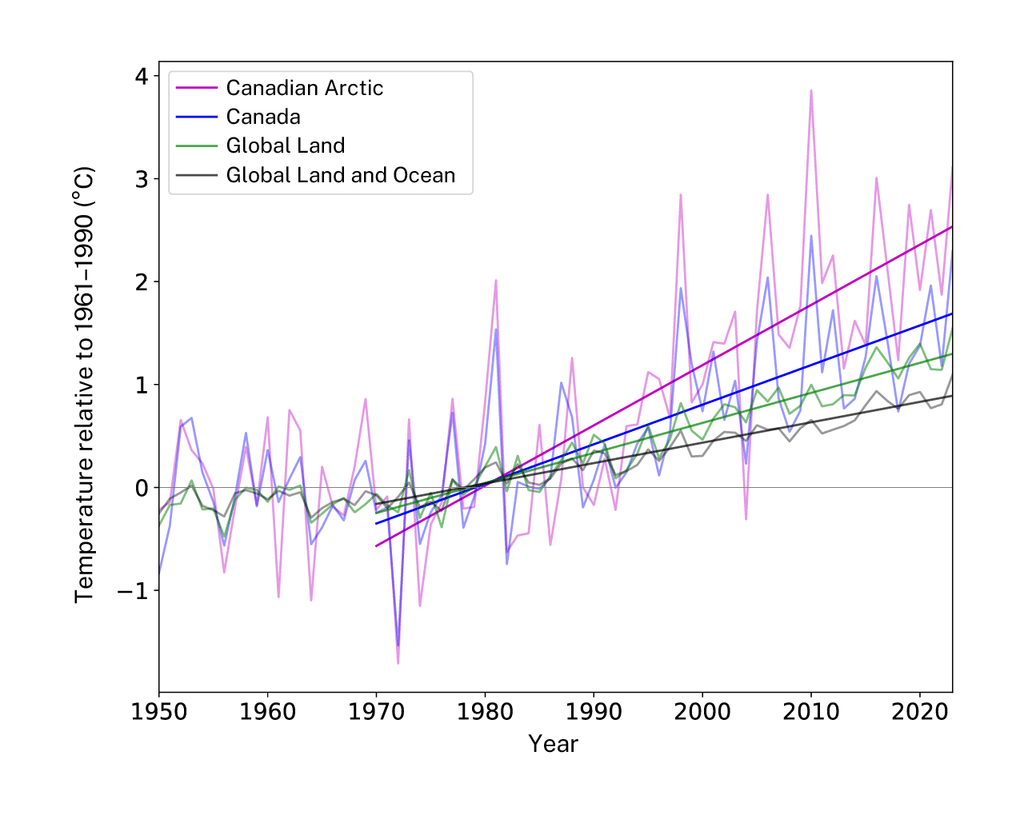
Figure: Observations of annual average surface temperature for the Canadian Arctic (magenta curve), for Canada as a whole (blue curve), the global land area (green curve), and the combined global land and ocean area (gray curve) from 1950 to 2023. The Canadian Arctic is bounded by 66.5°N to 83.11°N and 219°E to 307.38°E, which encompasses land north of the Arctic Circle and adjacent ocean areas. Source: Chapter 4, FAQ 4.1 Figure 1.