Designing Systems that can Withstand the Extreme Power Load Swings of AI Computation

November 10, 2026
By Blake Marchand
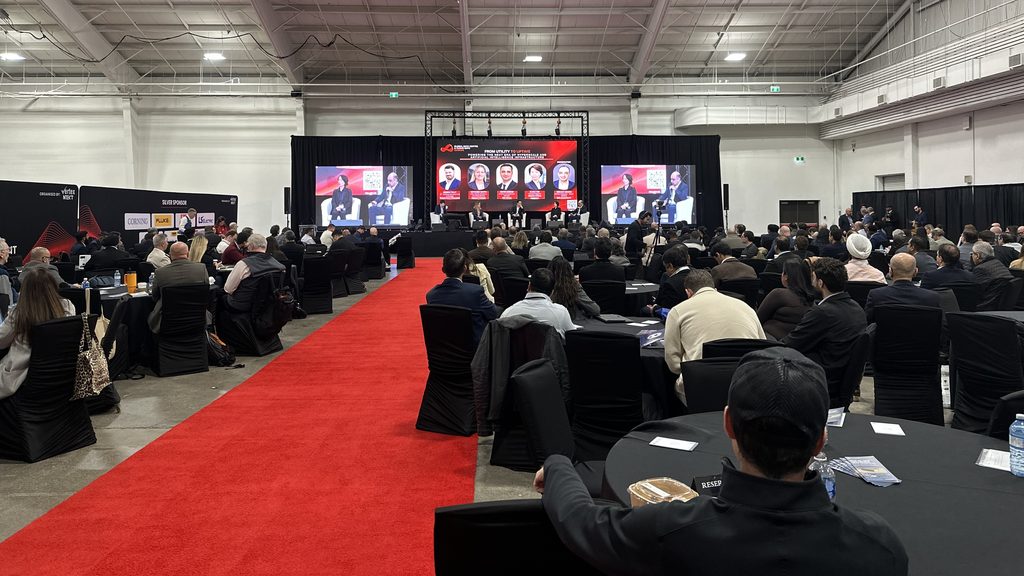
This year’s Global Data Centre & Cloud Expo featured a steady stream of programming through its two-day conference, held on October 20-21 in Mississauga, Ontario. Panel discussions and speakers highlighted an impressive range of topics relevant to all aspects of the data centre market.
This article focuses on a panel discussion titled From Utility to Uptime: Powering the Next Era of Hyperscale and Artificial Intelligence Infrastructure. I have narrowed in on comments from two of the four panelists, Alicia Yan, Principal Engineer, Mission Critical Engineers and Mehdi Mirzaie, Business Development Manager, CSA Group. Yan focused on the challenges related to AI computation load requirements and Mirzaie spoke to compliance. Our next article in this series will pick up the comments of other panelists from this discussion that provided considerations for securing power while also highlighting insights from other panel discussions that hit on similar topics like siting and modular construction.
One of the more interesting considerations from an electrical system perspective was highlighted by Yan, who discussed how the characteristics of the AI/computation load for modern data centres changes the system’s design and its risk profile.
Global Data Centre & Cloud Expo Canada
First off, Yan distinguished between hyperscale and high density. Often these terms are used interchangeably but they’re not the same concept. Looking back 10 years or so, a busy rack would draw 10 kilowatts. “Nowadays,” Yan said, “A single rack occupying the same space draws over 100, 120 kilowatts, and going higher. Often, they call it hyperscale, but, actually, it is a high-density computation load.”
Hyperscale refers to the amount of power coming into the site. High density refers to the computation load of the system.
“When we talk about hyperscale, that’s hundreds of megawatt power at the site, that’s just one step. We have power on site. How the power is being conducted onto the IT lab, that is a whole different topic.”
“What’s different than the traditional data center, is that the AI load is not sitting still, they come in as waves, as a swing. One moment all the loads, hundreds of thousands of GPU loads stay idling, and suddenly they all come in and swing to the peak.”
Yan explained that the challenge is how the system can handle those extreme swings in power load, which is something that has not been dealt with in the past.
“The load characteristic is creating new risk factors or single point failures that are different than before,” she said.
Yan highlighted that a single rack could exceed 100 kw, but as she explained, the racks will be idle and then suddenly peak, which creates challenges for reliability. That pattern repeats over and over like a heartbeat, she said.
The system becomes a single point of failure. All the components need to be able to handle the steady swings and swells of the AI computation load. Redundancy is not enough. All of the equipment needs to be able to withstand the repeated “heartbeat” of a data centre.
“We used to divide uptime through the redundancy. We double the generators, we double the utility feeds, and we double the path, and we double everything, the transformers, PDUs, and chillers. But now dealing with the AI load, it is different. Just the redundancy is not enough because every single equipment will feel the beat of that swing load, that AI computation model training.”
“So, can all the infrastructure equipment – the chillers, transformers, they all feel the heartbeat, can they take it? Even the busway connectors, can they take that kind of repeating the vibration? And the cooling goes the same way.”
The heat density determines the cooling technology that will be used. Rear door heat exchanger, direct to chip cooling, and immersion cooling. Direct to chip is liquid cooling, water is cycled through a heat sink or cold plate inside the equipment, although it only cools the chip rather than the whole cabinet. With immersion cooling the servers are submerged in a non-conductive dielectric fluid. A key challenge with immersion cooling is that it makes performing maintenance a longer process, as the racks have to be lifted from the fluid to dry out.
Cooling at a Glance
| Servers change? | Heat to liquid | Best fit today | |
| 1. Rear door | No | Nearly all of it, from the exhaust air; none at the chip | Existing halls, mixed hardware |
| 2. Direct-to-chip, single-phase | Cold plates fitted | Most (60–90%) | AI racks, new builds and retrofits |
| 3. Direct-to-chip, two-phase | Cold plates fitted | Most | Next-generation chips, early adopters |
| 4. Single-phase immersion | Approved for fluid, no fans | Nearly all | Edge, crypto, some HPC |
| 5. Two-phase immersion | Approved for fluid, no fans | Nearly all | Specialist; fluid supply in flux |
“Liquid cooling will bring a whole different landscape of the risk,” she noted.
In the current landscape that Yan described, when it comes to design, she said, “you have to take the whole system as one risk profile and design everything interconnected.”
“Can the liquid cooling take that kind of load? What happens when a single pump fails? And can the GPU ride through that kind of gap?”
Digital twins and managing power at the edge is a strategy that can be deployed to help address the challenges Yan highlights by detecting failures before they occur and anticipating the power swells.
As with many complex projects, discussions at the GDCC emphasized the importance of early planning on a project. This helps avoid costly headaches down the road in terms of the system design and commissioning, as well as securing power, investment, and community support. Investors, utilities, and communities want to engage with projects that have robust planning. As one panelist noted, investment firms will focus on projects that have an established energization date. Municipal approvals are being scrutinized as the public is increasingly educated on the data centre topic. They want clear information on the impact on the community when it comes to energy prices and water consumption, among other considerations. From the utility perspective, the amount of power required for these project means that utilities need to have concrete, long-term commitments if they are making investments to increase their capacity.
A similar point on the importance of planning was highlighted by CSA Business Development Manager, Mehdi Mirzaie. The entire system needs to be considered for compliance, not just the individual components.
Mirzaie noted that compliance needs to be engaged while the project is “still on paper”. This is to ensure that once a project is being installed you don’t wind up with small, non-compliant components jeopardizing a large project.
“Imagine OPG has done a tremendous job on the power side. Our friends in construction, engineering, and GCs or EPCs did a phenomenal job of preparing the data center for its energization. But suddenly, an Authority Having Jurisdiction or inspector might identify that a piece of medium voltage cable is not certified for its intended use, as an example, in the Canadian market or US market. Now, relatively, a very small piece of component might be (jeopardizing) a billion-dollar investment project. That’s why it’s super important to be on top of compliance.”
Mirzaie also pointed out that, when it comes to transformers and switchgear sourcing, due to the high demand, developers are increasingly looking to global markets for supply. Those products may not be certified for their intended use in the Canadian market.
Mirzaie noted that perhaps the most important piece is ‘ownership of compliance’, particularly when it comes to the fully integrated system. There can be some confusion when it comes down to who is responsible for compliance, with respect to the individual components, however once the components are fully integrated, the full system requires compliance.
Speed is a factor here, as well. New and developing technologies create challenges for compliance, which emphasises the importance of engaging compliance early in the project.
CSA takes a proactive approach to compliance, understanding the nature of mission-critical data centres operating under compressed schedules, narrow commissioning windows, and strict requirements. All of which highlights Mirzaie’s point of early engagement with compliance.
Although, the components and equipment may be individually compliant, you can still run into complications at the system and installation level, which includes:
- Equipment incorporated into custom or integrated assemblies
- Modified or imported systems
- Non-standard installation conditions
- Unclear acceptance criteria across design, construction, and inspection
These projects depend on system-level safety compliance and installation-ready documentation specific to the relevant AHJ (Authority Having Jurisdiction). The challenge for data centres is the complexity of the projects. Evolving designs and site-specific conditions create challenges for contractors and integrators. This places importance on establishing acceptance criteria, complete documentation, as non-standard configurations may result in confusion when it comes to system integration and equipment installation leading to costly delays.
The next article in this series from the GDCC explores other discussions from the Utility to Uptime panel, as well discussions from The New Wave of Modular Data Centre Models and Digital Capacity and Power Zones: The New Real Estate and Investment Playbook panels, which looked at siting data centres, power needs, supply chain, and modular construction.