Provinces Announce National Energy Corridor Agreement
March 10, 2026
Provinces and territories united to build electricity infrastructure and transform Canada into energy superpower
Following Ontario’s Connecting Canada – Building an Energy Superpower Summit in September 2025, provincial and territorial energy ministers agreed that expanding electricity transmission between jurisdictions is essential to meeting rising demand, strengthening energy security and unlocking the full value of Canada’s clean and diverse energy resources. The agreement marks a major nation-building milestone, breaking down longstanding barriers between provincial grids and enabling a more connected, resilient and self-reliant energy system.
The landmark agreement will bring together Ontario, British Columbia, Alberta, Saskatchewan, Manitoba, New Brunswick, Yukon, Prince Edward Island, Nova Scotia and the Northwest Territories to advance new electricity transmission projects and strategic interties across Canada.
“This initiative to work together on a national energy grid corridor is exactly the kind of nation-building project our country needs to strengthen cross-Canada connections, boost the reliability of the grid, and prepare ourselves for an increasingly electrified economy,” Tim Weis, senior director of the Pembina Institute’s Industrial Decarbonization program commented in a statement.
“We’ve underinvested in transmission in Canada, which means we’ve been missing out on opportunities to fully take advantage of each province’s strengths. For example, provinces like B.C., Manitoba and Quebec have significant hydropower resources and are natural batteries for Alberta, Saskatchewan, Ontario, and the Atlantic provinces which have abundant low-cost wind and solar resources. Bolstering transmission between these provinces can provide major reliability benefits, far exceeding the value of operational cost savings alone,” he said. “We trust that the federal Electricity Strategy, expected shortly, will take this effort to the next level by providing financial and policy support.”
Under this Canada-first agreement, provinces and territories will collaborate to:
- Identify and advance new interprovincial and territorial transmission infrastructure, including key intertie projects with elevated speed
- Expand electricity trade within Canada, helping regions meet growing demand and maximize the use of clean, reliable power before exporting abroad
- Advocate for federal support, including investment to accelerate transmission corridors and an electricity strategy that connects Canada east-west and north-south.
- Partner with Indigenous communities in energy development, ensuring meaningful participation and shared economic benefits
“A better-connected national grid will allow for a greater share of low-cost renewables by enabling the flow of electricity across regions to balance supply and demand, while long-distance transmission of clean power can help to minimize the need for provinces to rely on more expensive fossil generation, creating savings for ratepayers. This is good for both families and the industrial customers who need affordable, clean electricity to stay competitive,” commentated Ollie Sheldrick-Moyle, program manager at Clean Energy Canada in a statement.
“With the backdrop of global uncertainty, Ontario is emerging as a reliable partner at home and abroad focused on protecting jobs and our economy,” said Stephen Lecce, Minister of Energy and Mines. “Ontario has secured a landmark agreement to build an energy corridor that will strengthen our grid using Canadian materials, expertise and workers. This first-of-its-kind partnership lays the foundation for thousands of jobs, billions in investment, and a modernized grid that advances Canada’s long-term energy future. Together, we are advancing Made-in-Canada energy solutions to meet unprecedented energy demand and keep Canada’s economy strong.”
Canada’s grids were built for a different era — designed within provincial borders, rather than a modern economy. According to the North American Electricity Reliability Corporation (NERC) several jurisdictions across North America are currently labelled an elevated risk, requiring more power. Rapid population growth, major industrial expansion, critical mineral development and electrification are driving unprecedented demand for power, while limited interprovincial connections prevent regions from sharing reliable, clean electricity efficiently. Without action, these constraints will lead to higher costs, slower project development, and missed economic opportunities at a time when Canada must strengthen its energy security and global competitiveness.
Two-way trade in goods and services between Ontario and other provinces and territories was valued at more than $324 billion in 2024, underscoring the scale of economic activity that depends on stronger internal connections and reliable, affordable energy to move goods, power industry and support jobs across the country. By working together to modernize and connect their systems, provinces and territories are reducing duplication, lowering long-term costs and ensuring Canada has the infrastructure required to compete globally while remaining energy secure at home. This agreement reflects a shared commitment to build a truly Canadian electricity grid – one that supports regional development, attracts investment and ensures every part of the country benefits from Canada’s abundant energy advantage.
Additionally, Quebec supports the idea of enhanced collaboration between the provinces and territories to identify the most promising projects that meet market needs, provided that this collaboration respects the exclusive jurisdiction of the provinces. It also wishes to contribute to the effort to position the provincial and territorial energy sector on the world stage and is open to discussing concrete, economically viable projects that comply with North American market rules with interested parties.
Strong interprovincial partnership in energy supports the government’s plan to protect Ontario and is a key part of Energy for Generations, the government’s long-term approach to ensuring the province has the reliable, affordable power it needs to be energy secure and drive economic growth. The government’s integrated approach and record-setting investments in energy infrastructure are also providing the certainty needed for Indigenous communities, municipalities, businesses and industry partners to invest confidently in Ontario’s future.
Quick Facts
- According to Ontario’s Independent Electricity System Operator (IESO), the province’s demand for electricity is forecast to increase potentially as high as 90 per cent by 2050.
- As Ontario brings new nuclear, storage, and other clean energy projects online in the years ahead, the province will be positioned to expand – becoming a long-term, reliable supplier of clean electricity to other jurisdictions across Canada.
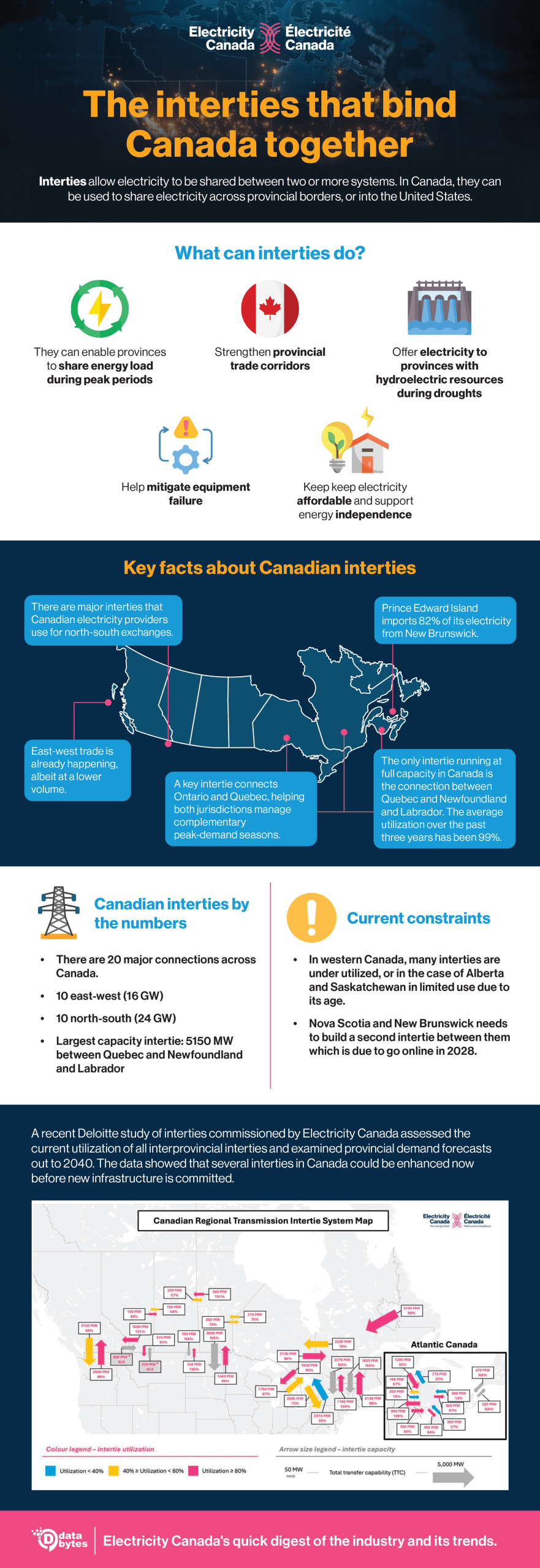
- Ontario currently operates 14 interties with two neighbouring provinces, three with Manitoba and eleven with Québec, representing a total export transfer capability of about 2,385 megawatts (MW) and a total import transfer capability of about 2,580 MW.
- In 2025, Ontario, exported 8.8 terawatt hours (TWh) of electricity to Quebec.
- Jurisdictions across Canada are looking to bolster their electricity supply.
Electricity Canada: The interties that bind Canada together: