Industrial Energy-Efficiency Study Shows Promise for Productivity
October 7, 2026
A recently released third-party study has found that the IESO’s energy-efficiency programs are having a positive impact on industrial productivity.
The study, which looks at the performance of energy-efficiency programs from 2021 to 2025 across four provinces, including Ontario, assessed the results of Save on Energy’s industrial energy-efficiency offerings involving over 950 projects. It found that every dollar provided through program incentives in Ontario is associated with $5.80 in total energy-efficiency spending in the form of capital deployment and reinvestment of energy savings.
The study ultimately identifies a close relationship between energy efficiency and productivity, with energy-intensive sectors able to support profitability and competitiveness by consuming less energy, and its findings suggest significant untapped potential to scale energy-efficiency and productivity gains across industry.
To learn more about how Save on Energy programs can help businesses, click here.
Industrial Energy Efficiency as a Driver of Productivity Study
Industrial energy efficiency (IEE) plays a critical but underrecognized role in improving productivity, profitability, and economic performance across Canada’s industrial sector.
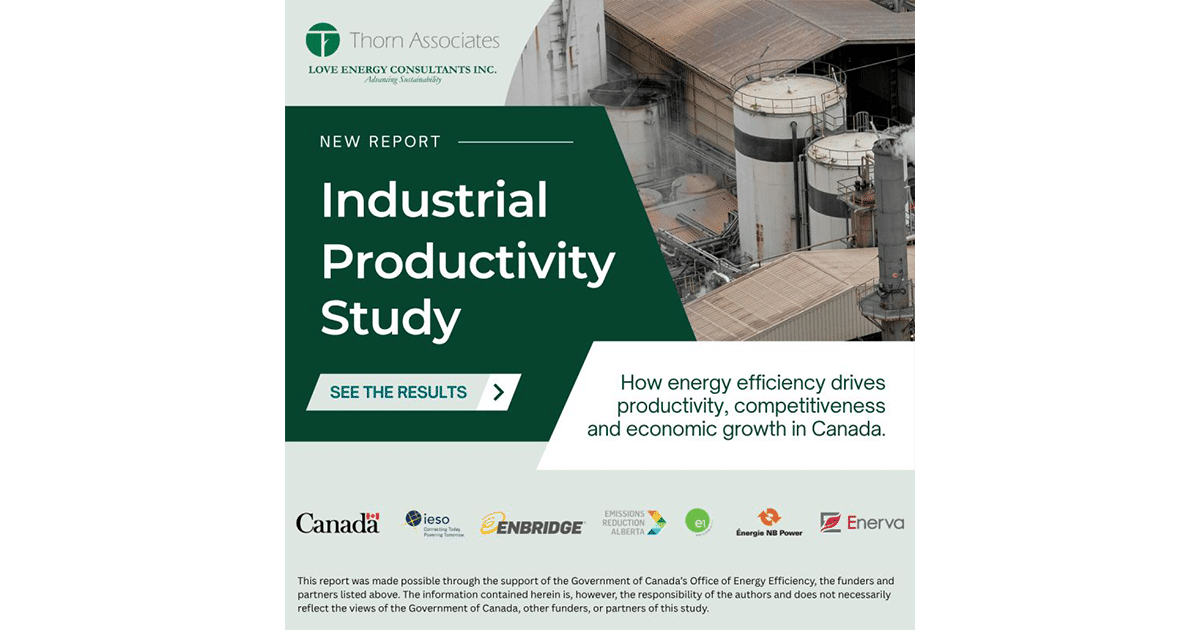
The Industrial Energy Efficiency as a Driver of Productivity Study provides a major Canadian assessment of this relationship, finding that investments in energy performance can generate benefits well beyond reductions in energy costs — contributing to higher labour productivity, stronger operational performance and greater industrial competitiveness.
Canada’s productivity challenge has become an increasingly urgent economic priority. In March 2024, Bank of Canada Senior Deputy Governor Carolyn Rogers described the country’s weak productivity performance as an emergency, declaring that “it’s time to break the glass.”
Supported by the Government of Canada’s Office of Energy Efficiency, Independent Electricity System Operator (IESO) and Enbridge Gas in Ontario, EfficiencyOne Nova Scotia, New Brunswick Power and Emissions Reduction Alberta, the study assesses 2,420 projects across more than 930 industrial firms, representing $1.07 billion in project investment and $176 million in incentive funding.
Energy efficiency as a productivity strategy
Conducted by Thorn Associates and Love Energy Consultants, the study highlights the importance of capturing the full value of IEE investments, including non-energy benefits such as improved productivity, reliability, maintenance and operational performance. Existing research suggests these benefits can add value equivalent to approximately 45% to 200% of direct energy cost savings.
Energy is both a controllable operating cost and an input to industrial production. Efficiency investments can reduce costs while improving equipment performance, reducing downtime and supporting modernization through automation, advanced controls and improved energy management.
“With the recent challenges of coming to a new trade agreement with the US, improving the productivity of Canadian industry becomes even more critical” says Peter Love, former Chief Energy Conservation Officer of Ontario and President of Love Energy Consultants.
The study finds a measurable relationship between energy efficiency and labour productivity, estimating that approximately $1 billion in IEE project funding could support an impact equivalent to a 1% improvement in labour productivity.
The financial opportunity for Canadian industry
At a time when industrial firms are navigating economic uncertainty, rising costs and pressure to remain globally competitive, IEE offers a practical opportunity to strengthen business performance. The study highlights the potential financial and economic benefits of expanding industrial energy efficiency investment:
- IEE projects across Ontario, Alberta, New Brunswick and Nova Scotia delivered or committed 26.4 PJ in energy savings — equivalent to the annual energy use of approximately 310,000 Canadian homes.
- The projects assessed are estimated to generate $5.01 billion in economic impact and support more than 39,000 jobs over 12 years.
- A 25% reduction in energy use could improve firm profit margins by approximately 4–6%, depending on energy intensity and operating costs.
- Expanding IEE participation from 13.9% to 75% could contribute to a 16.8% improvement in energy productivity, representing approximately $57.4 billion in economic impact.
- More than 77% of firms participating in the IESO’s IEE programs reported reinvesting in their organizations, highlighting the potential for efficiency investments to support continued business growth.
Thorn Associates’ Founder & CEO Emily Thorn Corthay states “Canadian industry is facing multiple headwinds from high energy costs due to the Iran war, increased supplier input costs, and tariffs on products exported to the US. This study demonstrates that investing in energy efficiency can pave the way to improved productivity and profitability.”