Rethinking Substation Protection: Why More Engineers Are Turning to Virtualization
May 20, 2026
By Kamyar Moghadam, Siemens Product Lifecycle Manager for Protection and Control
Ask any utility engineer what keeps them up at night, and you’ll likely hear the same answer: how to meet rising energy demand while modernizing an aging grid. Utilities today are being asked to expand capacity, integrate more renewables, and extend the life of aging substations often with limited staff and tight project timelines. For many engineers, this means finding ways to modernize protection and control systems without adding complexity or creating long outages. While traditional hardware-centric designs have been effective, evolving system requirements are increasing the need for more scalable and flexible approaches. In summary, it all boils down to simplicity, scalability and security.
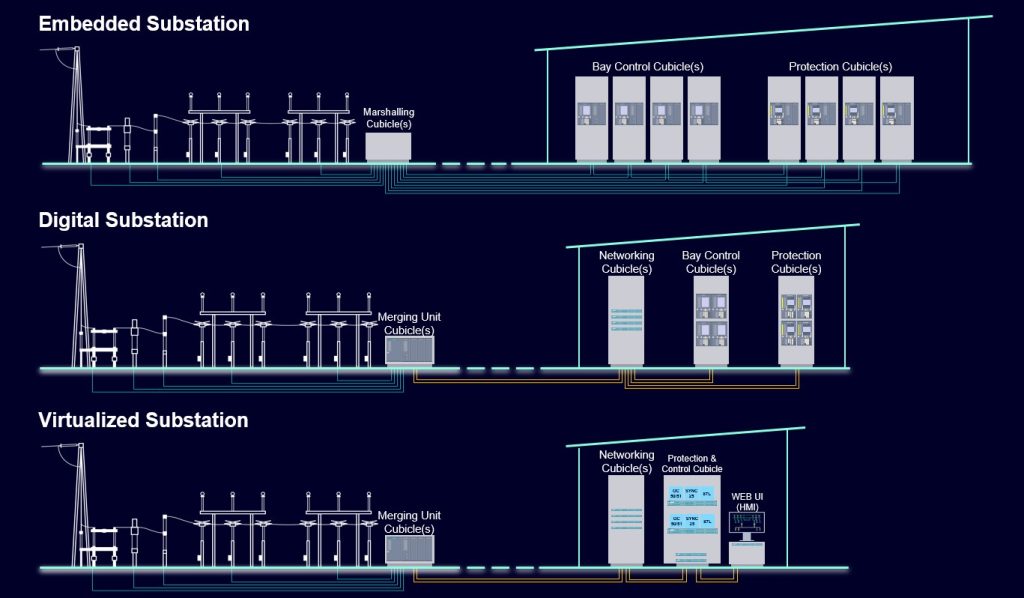
Digital substations have helped simplify communication and data exchange, but engineers are now looking at what comes next. Virtualization builds upon that digital foundation by shifting protection and control functions from embedded hardware into software-defined protection using the same trusted algorithms. This approach gives utilities more flexibility to adapt designs, reduce substation footprint, and modernize incrementally without rethinking the entire substation design.
The modern grid: challenges and pressures
The convergence of electrified transportation, hyperscale data centers, manufacturers, increased heating and cooling and distributed energy resources are driving a seismic shift in electricity demand and putting unprecedented pressure on the power grid.
Capacity expansion and modernization are happening at the same time, creating real tension on the grid. Utilities are expected to add more capacity and integrate renewables, all while working around equipment that may be decades old. Much of that infrastructure was never intended to handle bi-directional power flows, or the speed and volume of data generated by sensors scattered within the entire power grid. Additionally, systems operators need to adopt data driven decision making methods based on real-time data analytics using cutting edge technology.
There is also growing pressure to reduce the physical footprint and material intensity of substations. Traditional designs rely heavily on copper cabling, relay panels, and dedicated hardware for each function, adding cost, consuming space and increasing complexity. As senior engineers retire, knowledge transfer becomes harder, and maintaining consistency across projects takes more effort. Tools that simplify engineering, testing, and long-term maintenance are no longer a nice-to-have, they are essential to keeping systems reliable without overloading already stretched teams.
And then there is cybersecurity – a concern touching all elements of the substation. As protection and control systems become more connected, the attack surface grows. Securing hundreds or thousands of individual devices across a fleet is complex and time-consuming, especially when patching and access control are handled on one device at a time. Engineers are being asked to design systems that are not only reliable and fast, but also easier to protect over their entire lifecycle.
A vision for future-ready critical infrastructure
When utility operators consider the future needs of the grid, several priorities emerge. Systems must scale efficiently without requiring redesigns each time capacity expands. At the same time, day-to-day engineering and maintenance activities become more predictable and streamlined. As substations integrate with a growing number of systems and data sources, security must be embedded into the architecture from the outset.
Meeting these expectations requires an evolution in how protection and control systems are designed and delivered. The industry is increasingly adopting software-driven approaches, decoupling software functions from hardware, and enabling greater flexibility and scalability. Through this, engineers introduce new capabilities through software deployment and configuration, while minimizing physical changes within the substation environment.
This change affects how engineers think about protection systems as a whole – shifting from embedded hardware and software to software-defined solutions. In software-based architecture, protection and control logic run as applications on a centralized substation computing platform. The underlying protection philosophy remains the same, but deployment becomes more flexible. Updates, expansions, and adjustments can happen through configuration, rather than through new equipment orders and rewiring. Design, engineering, configuration and testing can be done conveniently at the office or in the lab. Using top-down engineering framework helps create standard designs leading to increased engineering efficiency.
The result is an approach that aligns more closely with how substations are expected to change over their lifetime. Engineers gain the ability to respond to new requirements without rebuilding what already works, making it easier to plan for growth while maintaining consistency across projects.
The virtualized approach to substation protection
Virtualization represents a meaningful change in how substations are engineered and operated, opening new opportunities for scaling systems while saving space and making the solution cost efficient. In a virtualized setup, protection applications can be deployed as software instances on a centralized computing platform. If computing capacity is available, expanding the protection scheme becomes a configuration task rather than a construction project. This significantly shortens the time between planning and energization.
Virtualization also changes how space and materials are used inside the substation. Consolidating protection and control functions into centralized server racks reduces the need for large relay panels and extensive copper cabling. Fiber based communication replaces much of the point-to-point wiring that traditionally fills control rooms. The result is a smaller physical footprint and a cleaner layout that is easier to build, document, and maintain over time. Reliability of the operation is also guaranteed by redundancy consideration at process, bay and station level as well as communication backbone.
Another important shift is how systems are tested. With virtualized protection, engineers can validate, test and optimize complete protection schemes in a digital environment before equipment is installed on site. Using this technology, logics, communication, and interactions between devices can be tested without the pressure of a live commissioning window. This reduces risk in the field and helps catch issues earlier, when they are easier to fix.
Why virtualized protection now?
The push toward virtualization is driven by a mix of practical and economic factors. Utilities are under pressure to control capital spending while still delivering reliable service. Reducing the number of physical devices in a substation can lower upfront costs, but the long‑term benefits often matter just as much. Fewer devices mean less maintenance, fewer spare parts to manage and simpler upgrade cycles over the life of the substation.
Virtualization also turns the substation into a more capable computing environment. Running protection and control on a server platform makes it easier to host additional applications locally, such as condition monitoring or analytics. Processing data at the substation allows engineers to act on insights quickly.
Security is another key consideration. Managing cybersecurity across hundreds of individual field devices is challenging, especially when updates and access controls must be handled one device at a time. Centralized server environments are easier to secure and monitor consistently. With role‑based access control and coordinated patching, engineers can maintain stronger security controls without adding unnecessary operational burden.
For utility leadership, virtualization offers a way to manage risk and control long-term costs. For engineers, it provides more flexibility in how substations are designed, expanded, and maintained. By shifting protection and control into software defined applications, teams can respond quickly to changing grid requirements while keeping proven protection principles intact.
Virtualized protection is not about chasing the latest technological trend. It is about removing constraints that make modernization harder than it needs to be and helping operation and maintenance teams make data-driven decisions. As energy demand grows and the grid continues to evolve, virtualization gives utilities a practical path to build systems that can change without constant rebuilding. For many engineers, flexibility is becoming just as important as the protection itself.
About the Author
Kamyar Moghadam P.Eng is the Product Lifecyle Manager for the Protection and Control product portfolio at Siemens Smart Infrastructure USA. Kamyar holds an Electrical Engineering degree and is a registered professional engineer with PEO. In his role, Kamyar provides support to customers and Siemens extended teams on product portfolio, applications, white papers and solutions.
In his 25-year career as protection and control engineer, Kamyar has worked with Siemens in Canada and the Middle East, GE Canada and Honeywell USA in various roles as commissioning engineer, application engineer, solution architect, proposal manager, site manager, business development manager, director of services and electricity line of business leader delivered several infrastructure projects.