Siting Data Centres: Behind the Meter Power, Supply Chain, Community Opposition, and the Trend Towards Modular and Prefabrication

November 25, 2026
Continuing our series from the Global Data Centre & Cloud Expo, this article unpacks discussions that took place on three panels: From Utility to Uptime, The New Wave of Modular Data Centre Models, and Digital Capacity and Power Zones.
Generally, there are five factors impacting data centre developments currently: the availability of power, availability of equipment, availability of skilled labour, commissioning timelines, and community planning and approvals.
When it comes to data centre development, new growth is targeting areas that are power rich. In the near term, due to the power demands, reliability, and the speed of development, developers are focused on natural gas. That focus is also behind the meter. In Alberta, for example, where natural gas is abundant, the regulated approach is highly competitive and planned several years ahead. The timeline and uncertainty can create challenges for data centre developers because bids for natural gas capacity can go into the 2030s. To secure power sooner, the focus is on non-regulated pipeline networks, behind the meter.
Developers don’t want to waste their time in pursuing a project that will get held up by opposition from community members. The other consideration for siting is supply chain and procurement for switchgear and substations. This puts emphasis on the planning phase of the project and engagement with communities, stakeholders, indigenous communities, and customers.
Several panelists were focused on natural gas. As mentioned, it is often the fastest to procure compared to other options given the power demands of large data centres, it is also cheap, particularly in Alberta. However, other panelists, like Aiden Kirchmair, President and Partner at Eskay Capital, noted supplementing natural gas with renewables is important to decrease the carbon footprint.
Keegan Tully, Vice-President of Business and Services, Ontario Power Generation recognized natural gas as a stopgap measure until they can develop more nuclear capacity. Data centre operators don’t want to wait 10-20 years until nuclear is developed.
Tully noted that due to the speed and scale required by data centre partners, natural gas will be utilized in the near term, supplemented with renewables, until they can add to their nuclear fleet. He noted that they need long term commitments to ensure that buyers are there for their power once it is developed.
“We hear loud and clear the speed to power is essential and that really means gas. I think, in general, there is capacity on the grid in the right locations in Ontario, but if we want more power beyond that, gas is one of the fastest technologies,” Tully said.
Nuclear provides the stable baseload power that data centres need without the emissions of natural gas. Tully said that is their long-term plan, but again, he emphasized that they need to have certainty that data centre customers creating demand will be there in the long-term, so that the investment is not stranded.
Ultimately, developers need to see a clear path for their data centres. There needs to be easy access to power, communities willing to host projects, and access to supply chain. A key to ensuring these things is relationship building, community engagement, and a collaborative approach. All from an early stage.
“At OPG we see a role for gas in the near term but then how you couple that with renewables to reduce the emissions. In the longer term we’re developing small modular reactors, we’re developing new large nuclear assets and so we would like to see that transition over time into non-emitting resources,” Tully said. “Nuclear is a great match for data centers, its stable baseload power, and that’s exactly what the data centers need. And so, we’re really looking to work with the people (at the GDCC) to find a way to develop that longer term.”
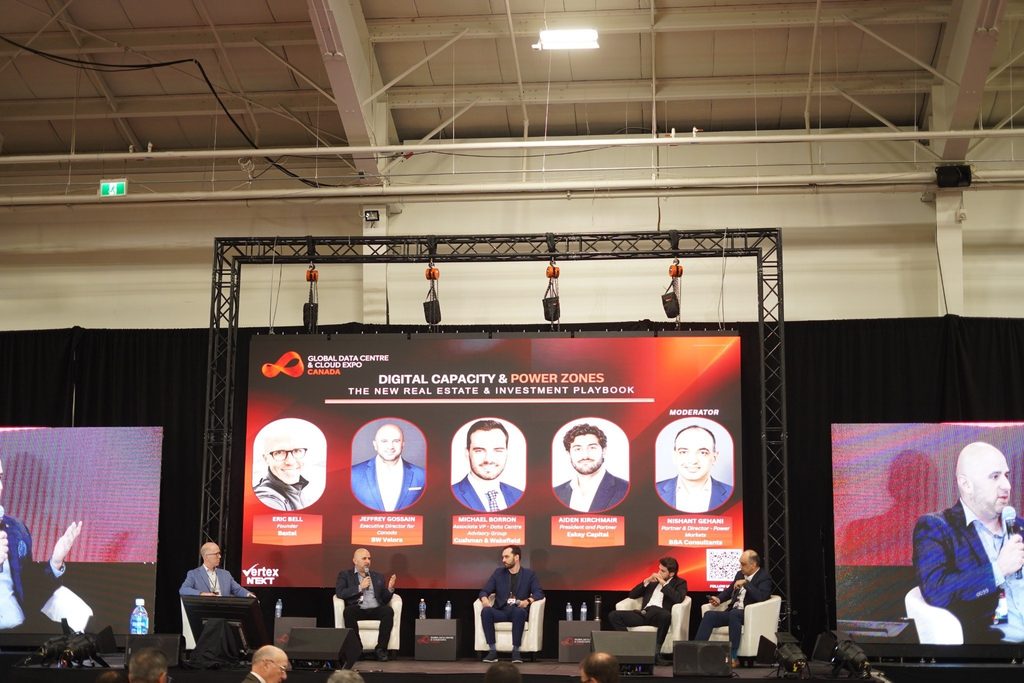
Jeffrey Gossain, Executive Director at BW Velora, said they focus their efforts on sites where they can get gas earlier, “which is the non-regulated pipeline networks.”
“You’re not just looking at power, but you’re looking at citing the right location to make sure that you’re not going to have a community opposition.”
It is important to work with indigenous communities, as well, he said, “in addition to that, you have to work on the supply chain.”
However, Gossain said, “the reality is that in our areas, developing the power is actually the hard part. The data center is not difficult. From a regulatory perspective, 80% of our effort and budget is spent on the power client.”
Kirchmair said his firm focuses on projects that have a real energization date, “You don’t want to just have something that’s coming in who knows when. And that’s why, to Jeffrey’s (Gossain) point, we’re seeing a lot more behind the meter sites because there’s so much demand for compute and there’s not enough power.”
Modular and Pre-Fabrication in Data Centre Development
There are several positives to a modular approach to data centres. Pre-fabrication leads to more predictability and repeatability. Off-site construction eliminates any challenges related to weather, and also provides more control over supply chain.
“As AI growth has taken over the data center industry, every off-taker wants their data center to be delivered yesterday,” explained Ahmed Anwar, Head of Construction at Prometheus Hyperscale. “So, to keep up with that, most of the construction industries have figured out they can take the construction off-site, hence modularizing off-site, where you have more control over your resources, you have a supply chain confirmation that you can build your schedule around.”
“When you prefabricate a mechanical component or an electrical component, you’re doing it in bulk.”
“If something becomes more repeatable, you have a better assurance of the economics of the project’s return, as well,” Anwar added later on in the discussion.
Additional, prefab construction can help address some constraints related to labour. It is easier to develop a dedicated specialized, skilled workforce if you are working from a dedicated location. Rather than having to move the workforce around the province, or find labour in each project location.
Often data centres are located in areas that are more remote, which can complicate the supply chain and product delivery. In a controlled prefabrication environment, a lot of logistical headaches can be avoided. There are also infrastructure requirements for the camp to support the workforce that can be mitigated by a smaller workforce at the site. Instead of building a camp for 4,000 workers, you may only need a camp to support 500 workers.
It also benefits manufacturers from a quality control perspective.
Modular data centres make it easier to adapt to evolving technology, as well as new data centre tenants. Technologies deployed in data centres have been evolving rapidly, and are likely to continue that evolution.
Anwar explained a general scenario in favour of modularity and adaptability to new technologies, more computing demand, as well as the requirements of a new tenant.
“You’re changing out server racks from a 15KW server rack to a 50KW server rack because your next tenant wants more compute out of that rack. When someone changes a server rack, you have to worry about the electrical configuration and the cooling aspect for that new server rack.”
So, modularity, prefabrication, becomes that much handier for not just the microscaler, but also the general contractor who’s actually installing the equipment.”
Just imagine you have, in the right space, a row of 22 racks that you might need to replace. Wouldn’t it be better if you can do all those infrastructures offsite all at once and then have one downtime in a live data center environment rather than doing one rack at a time? I think there’s a lot of benefit of doing the modularity, even for repeatable requirements.”
Additionally, if you start with a smaller facility at 30 to 50 megawatts, it may be more palatable to the community. Once the data centre is operational, the community may be more open to growth when it sees the benefits related to job creation.
Speaking from a municipal/regulatory perspective, Mitch Davidson, Vice President with political consulting firm, Enterprise Canada, explained how the modular approach could potentially help ease some of the concerns for communities. He also noted that, from a permitting perspective, he sees things getting slower rather than speeding up, due to concerns in communities.
“I would say one of the big pieces of concern around data centers is the scale in which they’re coming on and the amount of power that they’re going to take. And the modular approach really helps solve a lot of that problem really early on in the respect that you can continue to sort of upgrade and build and grow piece by piece rather than all at once,” he said.
“It allows the products to adequately plan for that additional electrical capacity and do so in a way that’s reasonable, pragmatic, isn’t going to shoot hydro bills through the roof for everyday consumers because we know there’s already some local opposition to take data centers as well as local support.”
The third article in this series from GDCC unpacks the closing keynote address Calista Redmond, Vice President of Global AI Initiatives, NVIDIA who provides perspective on the AI data centre ecosystem and use-cases for how utilities are using AI to streamline operations.