NERC: Resource Adequacy Risks Intensify Across North America as Demand Growth Surges
February 9, 2026
NERC’s 2025 Long-Term Reliability Assessment (LTRA) and infographic spotlight intensifying resource adequacy risks throughout the North American bulk power system (BPS) over the next 10 years. Summer peak demand is forecast to grow by 224 GW, a more than 69% increase over the 2024 LTRA forecast with new data centers for artificial intelligence and the digital economy accounting for most of the projected increase. Winter demand growth continues to outpace summer demand growth with 246 GW of growth forecast over the next 10 years, reflecting the evolution of electricity usage. Uncertainty and lag in the pace of new resource additions are driving heightened concerns that industry will not be able to keep up with rapidly increasing demand.
“The report highlights rising resource adequacy challenges across many regions as electricity demand accelerates and supply mixes change. Against this backdrop, Ontario stands out as a reliable planning area in North America, supported by years of intentional planning and consistent execution,” the IESO said via LinkedIn.
“NERC’s assessment shows Ontario’s anticipated reserve margins remain above reference levels for much of the 10-year outlook. This outlook reflects Ontario’s long-term planning approach, featuring recent procurements – including contributions from the Long-Term 1 procurement, increasing system flexibility and the growing role of energy storage.
The IESO continues to plan for significant growth in electricity demand, which is projected to rise by more than 30 per cent over the next decade and reach nearly 30 GW by 2035, driven largely by electrification and new industrial loads. The report also highlights Ontario’s expanding system flexibility, with more than 2,700 MW of new battery energy storage expected to be in service by 2028.
Overall, the 2025 LTRA affirms that Ontario’s electricity system is on a strong and stable planning path, while reinforcing the importance of staying focused and agile as the system continues to evolve.”
“This assessment is not a prediction of failure but an early warning on the trajectory of risk,” said John Moura, director of Reliability Assessment and Performance Analysis. “The path forward is still manageable but only if planned resources come online and on time.
The risk of electricity supply shortfalls is increasing during winter conditions, as generators with diverse fuels retire and are replaced predominantly by solar and batteries and natural-gas-fired generators. This trend in resource additions is reflected in the 2025 LTRA, released today, which finds that new battery resource projects have grown to match solar projections. In addition, natural-gas-fired generator additions represent 15% of the projected capacity additions, followed by wind and hybrid at 8% each. While interconnection queues continue to grow, considerable uncertainty surrounds the timing and amount of resource additions.
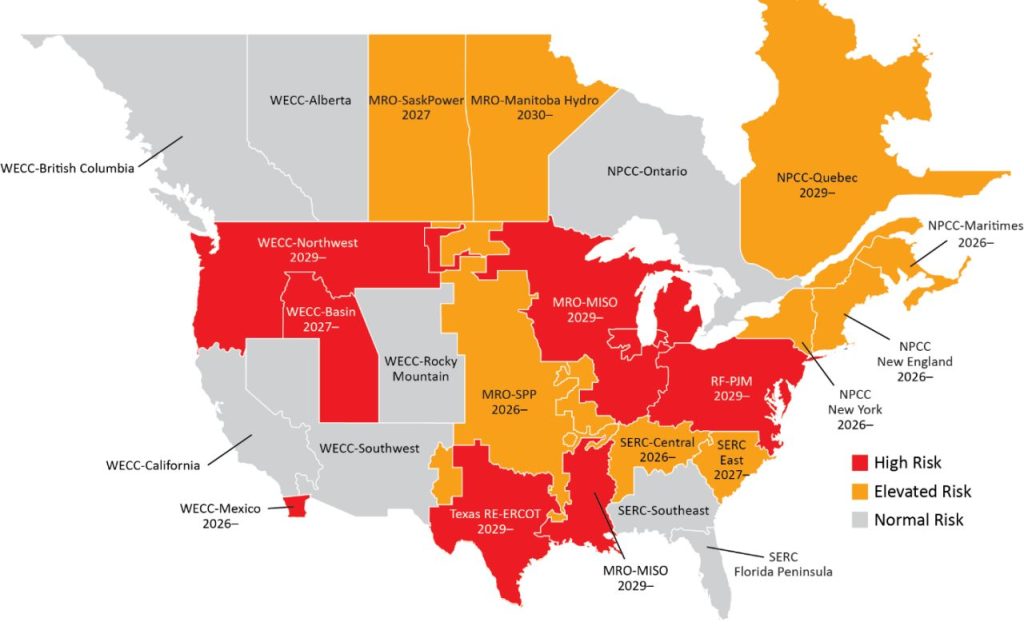
“As these concerns have grown more acute, more action has been taken by industry and regulators to bolster resources,” said Mark Olson, NERC’s manager of Reliability Assessments. “Although projected retirements remain high with 105 GW of peak seasonal capacity planned for retirement over the next 10 years, this number has reduced by 10 GW since the previous LTRA. In addition, market mechanisms such as capacity accreditation have been launched, more precisely highlighting the loss-of-load risks posed by a generation mix that has increasing amounts of variable resources. Also, industry is reacting to the changing conditions with growing demand and evolving planning methods that highlight the potential need to keep resources on-line longer than previously anticipated.”
To mitigate the reliability challenges over the next 10 years, NERC recommends streamlining infrastructure development (both gas and electric), managing generator deactivations, undertaking robust adequacy assessments, and coordinating electric-natural gas system planning and operations.
Specific recommendations include the following:
- Integrated Resource Planners, market operators, and regulators should expedite new resources to meet growing demand and carefully manage generator deactivations.
- NERC, industry, and regulators should understand and manage reliability risks accompanying large-load growth and leverage potential capabilities in new types of loads to provide flexibility to operators during times of grid stress.
- NERC, the Regional Entities, and industry should improve the LTRA by incorporating wide-area analysis, risk scenarios, and criteria to inform stakeholders of future reliability risks.
- Regulators and policymakers should streamline siting and permitting processes to remove barriers to resource and transmission development.
- Regional Transmission Organizations, Independent System Operators, and the Federal Energy Regulatory Commission (FERC) should continue to ensure that essential reliability services are maintained.
Undertaken annually in coordination with the Regional Entities, NERC’s 2025 LTRA is the Electric Reliability Organization’s independent assessment and comprehensive report on the adequacy of planned BPS resources to reliably meet the electricity demand across North America over the next 10 years. The 2025 LTRA includes a probabilistic assessment and the use of energy risk metrics to identify potential supply shortfalls.