Report: Over 2 in 3 Canadian Heavy Industry Workers Received No Formal AI Support from Their Employers
October 7, 2026
AI is making its way onto factory floors, construction sites, and farms across Canada, but most heavy industry workers have been given no formal guidance on using the technology, according to new research from Punchcard Systems, an Edmonton-based digital innovation consultancy.
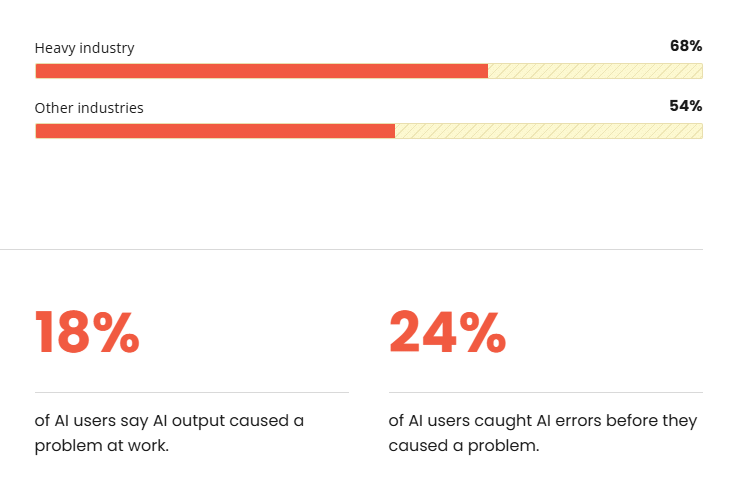
Nearly half (49%) of Canadian heavy industry workers already use AI for work, yet over two in three (68%) have received no formal AI support or training from their employers. That figure rises to 87% of construction workers, the least supported sector in the study.
This is according to Punchcard’s The State of AI in Canada’s Heavy Industries, developed in partnership with Angus Reid. The report surveyed 1,100 working Canadians across a wide variety of industries to understand how AI is changing their day-to-day work and the tasks where they trust AI the most or the least.
“The people closest to the work already know where AI helps and where it creates risk,” said Sam Jenkins, Managing Partner at Punchcard Systems. “When employers give them proper guidance and a real say in how it’s used, leaders get a much clearer picture of what AI can do for their organizations. The most meaningful AI gains come from rethinking how the work gets done, rather than bolting an AI tool onto outdated workflows and processes.”
Utility Insights
Most electric/utilities workers use AI, but they’re still cleaning up after it
- Nearly three in four (73%) electric/utilities workers use AI for work (vs. 52% nationally).
- Electric/utilities workers are the most likely heavy industry sector to use AI for work, second only to public admin and government workers (76%) overall.
- Only 27% of electric/utilities workers use Canadian-made AI technology.
- Nearly six in ten (59%) electric/utilities workers say Canadian-made AI technology represents 50% or less of the AI tools their organization uses, and 32% say none of the AI tools their organization uses are Canadian-made.
- About one in three (35%) electric/utilities workers say AI tools make their job noticeably easier but they could manage without them (vs. 46% nationally).
- Meanwhile, over half (54%) of electric/utilities workers say they use AI tools occasionally and would barely notice if they disappeared (vs. 45% nationally).
- Despite leading heavy industry in AI adoption, only 3% of electric/utilities workers say they couldn’t do their job to the same standard without AI (vs. 6% nationally).
- Electric/utilities workers who save time with AI save an average of 6.3 hours per week. Meanwhile, 29% say AI tools do not save them any time at work.
- Electric/utilities workers are the least likely of any sector to say AI doesn’t save them any time at work (29% vs. 35% nationally).
- Among electric/utilities workers who say AI tools have saved them time, 33% say they have more free time or less pressure in their day, while 38% say they have more output, or a heavier workload is expected of them.
- Electric/utilities is the only sector where AI’s time savings are more likely to turn into more output or a heavier workload (38%) than more free time or less pressure (33%).
- Nearly all (97%) electric/utilities workers rework AI-generated output before they can use it.
- Electric/utilities workers are the most likely of any sector to rework AI output, and to rework more than half of what AI produces (44% vs. 31% nationally).
- More than one in ten electric/utilities workers (15%) say AI-generated output has caused a problem at work, while 24% say AI errors were caught before they caused a problem.
AI is rewriting electric/utilities workers’ jobs, but many have received no formal support from their employers
- More than four in ten electric/utilities workers (41%) say AI has impacted their role (vs. 44% nationally).
- The top AI-driven changes to electric/utilities workers’ roles are reviewing or fact-checking AI-generated work becoming a regular part of their job (29%), taking on new AI-related responsibilities without a change in their title or pay (9%), and having parts of their job that they used to do themselves now handled by AI (9%).
- Electric/utilities workers are the most likely of any sector to say fact-checking AI is now a regular part of their job (29% vs. 19% nationally), more than three times the rate of manufacturing workers (9%).
- More than one in ten electric/utilities workers (15%) say their AI usage is tracked or monitored by their employers (i.e. token usage, number of prompts, or activity inside AI tools), and 6% say their employer or manager currently requires them to use AI in their work.
- More than one in three electric/utilities workers (37%) say they have received no formal support from their employer when it comes to AI at work, while over half (57%) say they have received formal support.
- Electric/utilities workers are the best supported sector, and the most likely of any sector to have received an approved list of AI tools they’re allowed to use (43% vs. 19% nationally). They’re also tied with public admin and government workers as the most likely to have written rules about what company or customer information can be entered into AI tools (35% vs. 16%).
Electric/utilities workers trust AI with the paperwork, but not the risky calls
- Electric/utilities workers trust AI the most for looking up routine procedures, product specs, or how-to information (79%), writing up or summarizing reports, logs, or job paperwork (74%), and anything involving Canadian codes and standards (47%).
- Electric/utilities workers are the most likely of any heavy industry sector to trust AI with looking up routine procedures (79%), but the least likely to trust it with calculating loads, materials, measurements, or dosing ratios (26% vs. 47% nationally) and reading technical drawings (35% vs. 52%).
- Electric/utilities workers are least likely to trust AI with decisions that affect worker safety or carry a physical risk (71% don’t trust it at all), calculating loads, materials, measurements, or mixing and dosing ratios (56%), and reading or interpreting technical drawings, manuals, or spec sheets (53%).
- Electric/utilities workers are the most skeptical heavy industry sector, and the most likely to distrust AI on every high-stakes job-site task in the survey, including decisions that affect worker safety (71% vs. 45% nationally), calculating loads (56% vs. 26%), reading technical drawings (53% vs. 32%), diagnosing equipment faults (41% vs. 31%), and interpreting safety, compliance, or code requirements (41% vs. 26%).
Heavy Industry, Construction, and Worker Insights
Is AI saving Canadian workers time, or creating more work?
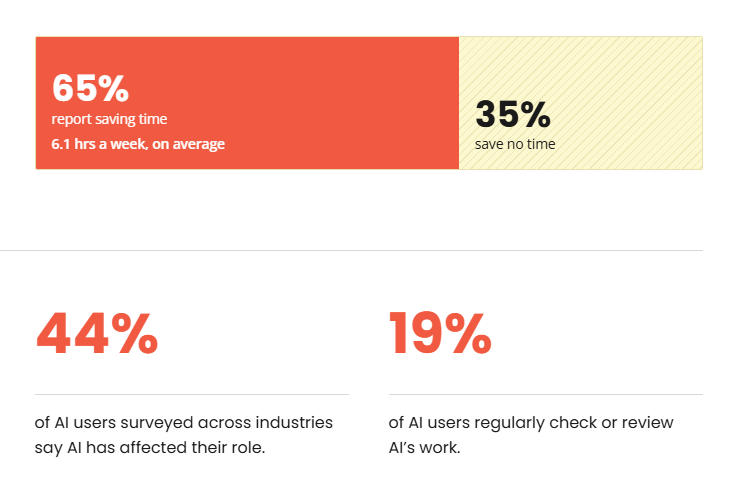
It’s doing both. Workers who save time with AI gain back hours each week, but nearly everyone who uses it still has to fix what it produces, with many catching AI errors before they cause an issue at work.
- Over half (52%) of Canadian workers overall use AI for work. However, the adoption rate varies by industry (49% in heavy industry vs. 57% in the service sector).
- ○ Public admin and government workers are the most likely to use AI for work (76%), while automotive workers are the least likely to adopt the technology (36%).
- Canadian workers who save time with AI save an average of 6.1 hours per week.
- Nearly all (94%) Canadian workers rework AI-generated output before they can use it.
- About one in six Canadian workers (18%) say AI-generated output has caused a problem at work, while 24% say AI errors were caught before they caused a problem.
Are Canadian employers training workers to use AI?
For most workers, the answer is no. Construction workers are the least supported sector, with 87% receiving no formal AI support, followed by agriculture (77%), manufacturing (67%), and transportation and logistics (65%).
The lack of support persists even as AI has impacted many Canadian workers’ jobs.
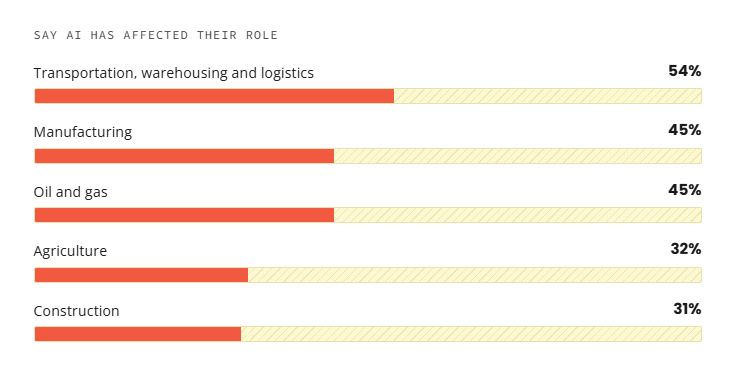
- More than four in ten (44%) Canadian workers overall say AI has impacted their role, rising to 54% for transportation and logistics workers, 52% of professional services workers, 45% for manufacturing workers, and 45% for oil and gas workers.
- For many, the biggest change is a new layer of review work added to their day. About one in five (19%) say reviewing or fact-checking AI-generated work is a regular part of their job.
- One in ten (10%) workers say their employer tracks or monitors their AI use, such as token usage, number of prompts, or activity inside AI tools.
Only 6% of workers who use AI say they’ve been given formal responsibility for AI governance, policy, or safe use at their organization.
Workers whose employers provide formal AI support are three times as likely to hold that responsibility (9% vs. 3% of those whose employer has provided none), suggesting that the gap in governance is closely tied to the broader gap in support.
Which tasks do Canadian workers trust AI with?
Mostly routine ones. Workers are comfortable handing paperwork and lookups to AI, but many draw the line at decisions that carry physical, financial, or safety risk.
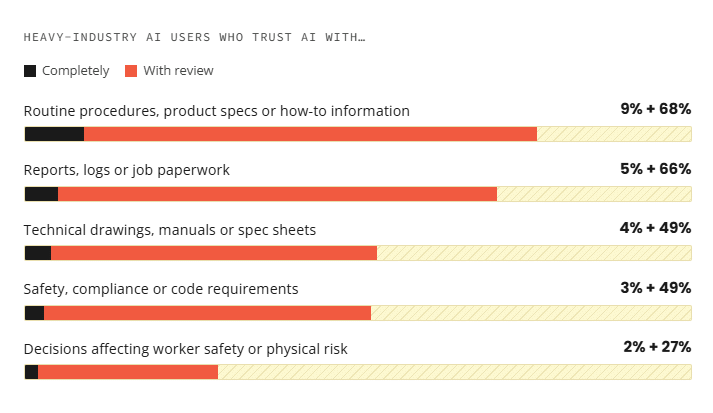
- Heavy industry workers trust AI most for looking up routine procedures, product specs, or how-to information (77%) and writing up reports, logs, or job paperwork (71%).
- Nearly half (45%) of heavy industry workers don’t trust AI at all with decisions that affect worker safety.
- Construction workers are among the most willing to trust AI on high-stakes tasks, as long as they can review what it produces. Nearly two in three construction workers trust it to read technical drawings (64%) and interpret Canadian codes and standards (63%).
- While 36% of construction workers trust AI on decisions that affect worker safety as long as they review it, none say they would trust it completely with those safety decisions.
These findings suggest the next stage of AI adoption in Canada will depend on how well organizations keep people involved in the decisions AI touches, and whether their tools and rules are built for the work their teams actually do. Punchcard works with organizations to modernize outdated systems and build custom AI tools, with clear rules on where a person needs to make the call.