Building Grid Resilience Through Interprovincial Interties: Bill C-39 Will Help Canada Build the Electricity Grid it Needs

October 7, 2026
Bill C-39 marks an important step toward building Canada’s electricity system faster, according to industry association Electricity Canada.
By streamlining federal approvals, improving regulatory certainty, reducing duplication, and creating a clearer pathway for critical transmission, nuclear, and hydroelectric projects, the legislation helps create the conditions needed to build the infrastructure that Canadians and the economy increasingly depend upon.
Bill C-39 includes important developments for Canada’s electricity sector, including:
- A streamlined approval process for transmission projects, including a single-review model through the Canada Energy Regulator (CER) and reduced duplication between federal agencies.
- More predictable timelines for major transmission infrastructure, providing greater certainty for utilities, investors, Indigenous partners, and governments.
- A single-window approach for nuclear project reviews, creating greater clarity and efficiency for large nuclear and Small Modular Reactor projects.
- Consolidated federal permitting for major hydroelectric and generation projects, reducing administrative burden and improving coordination across departments.
- A stronger pathway for interprovincial transmission and interties, which are essential to improving regional integration, reliability, affordability, and energy security.
While implementation details and future regulations will be important, Electricity Canada looks forward to working with the federal government to ensure these reforms deliver meaningful improvements for electricity projects across the country. This includes interprovincial transmission, which according to a new report released from Electricity Canada and the Open Insights initiative, led by researchers at the University of Victoria could reduce the expected frequency of grid-level outages during extreme weather events.
The findings from the Electricity Canada / Open Insights report highlight the importance of expanding interprovincial transmission and strengthening regional grid integration as Canada builds a more reliable, resilient, and affordable electricity system.
Report Highlights
Four system-level findings emerge consistently across the corridors studied:
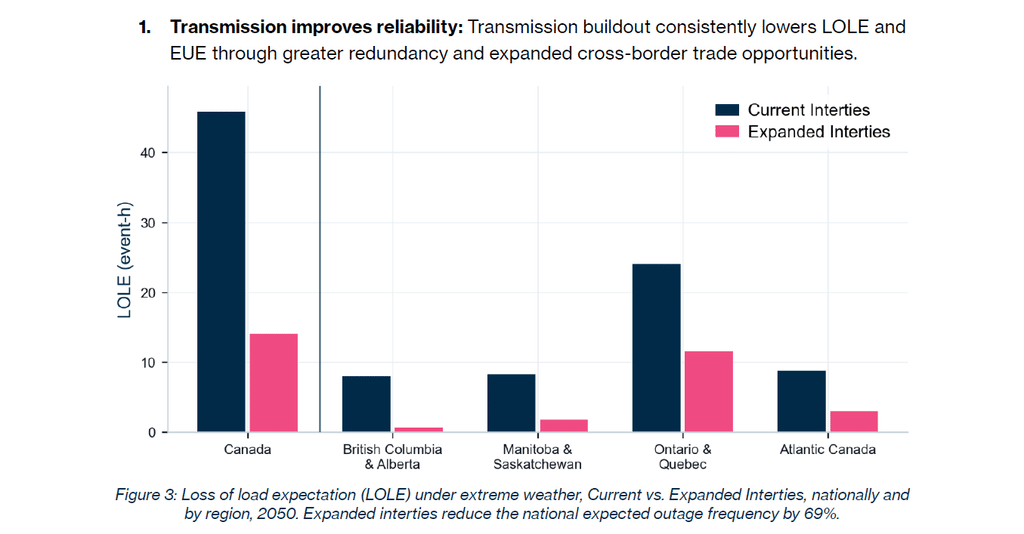
- Transmission improves reliability: Transmission buildout consistently lowers LOLE and EUE through greater redundancy and expanded cross-border trade opportunities.
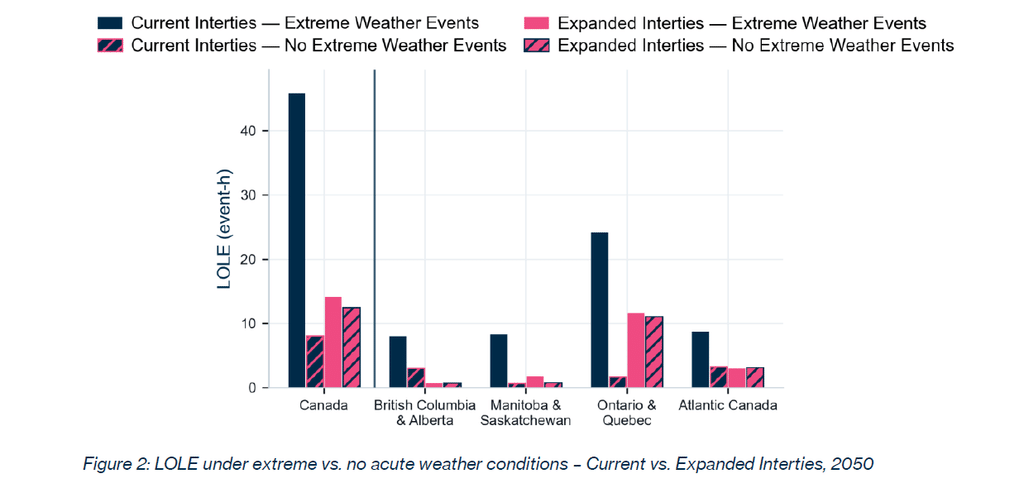
- A weather-resilient grid: Interties enable access to less heat-affected generation during the summer, while leveraging cold-weather capacity gains to meet elevated winter demand, insulating the grid from weather shocks.
- Lower costs: Building generation and transmission together achieves cost savings while boosting system reliability.
Expanding interties lowers net system costs in every corridor. Figure 6 breaks the difference in each corridor’s annual cost into five components: generation capital, generation operating cost (fixed and variable O&M, fuel and carbon), transmission, import costs and export revenue. All values are annual costs in 2024 Canadian dollars relative to the no-new-interties baseline.
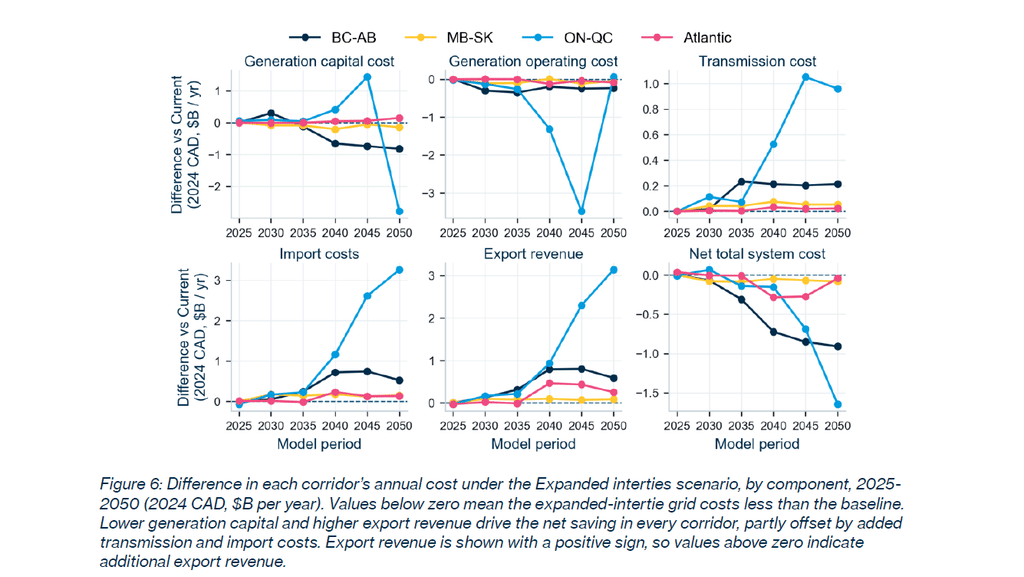
The pattern holds across corridors: coordinated buildout displaces generation capital and raises export revenue, and together these outweigh the added transmission and import costs. Every corridor’s total system cost ends up below the baseline by 2050, with savings widening over time. Export revenue is plotted with a positive sign, so a value above zero means the corridor earns more export revenue under expanded interties than under the baseline.
- Lessons for nuclear-dominated grids: While thermal capacity is usually considered more reliable, sustained heat reduces the capacity available from thermal-reliant grids because of cooling requirements and environmental restrictions. Interties reduce that exposure by giving a heat-affected province access to resources whose output is not correlated with its own air temperature. In Ontario, a large share of the nuclear fleet draws cooling water from the Great Lakes, which moderates the impact of air temperature changes. But the plants are restricted by the permitted temperature rise at the discharge, which is referenced to ambient lake conditions and so tightens as the lake warms (CNSC, 2012). That limit applies unevenly across the fleet. Section 3.3.3 sets out the mechanism and explores the extreme bounds.
The corridor-level results that follow show how these four findings play out in each region, and where local circumstances depart from the general pattern.
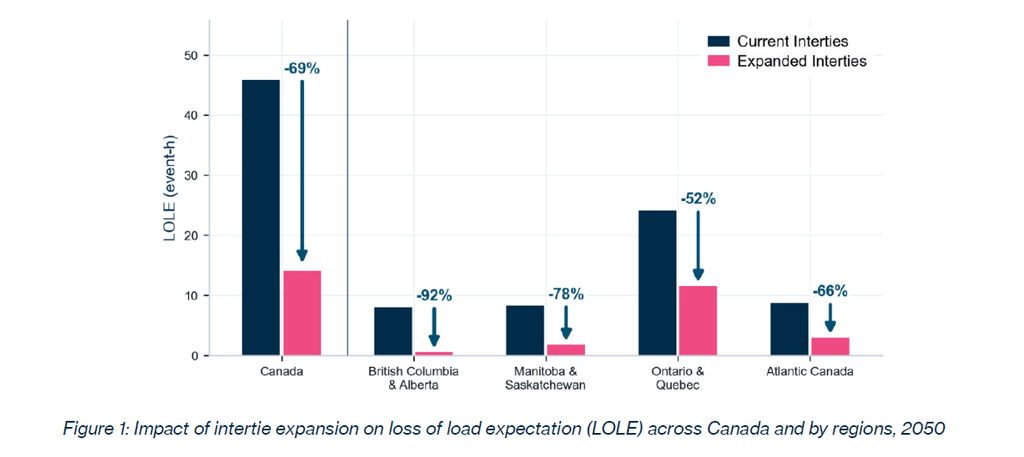
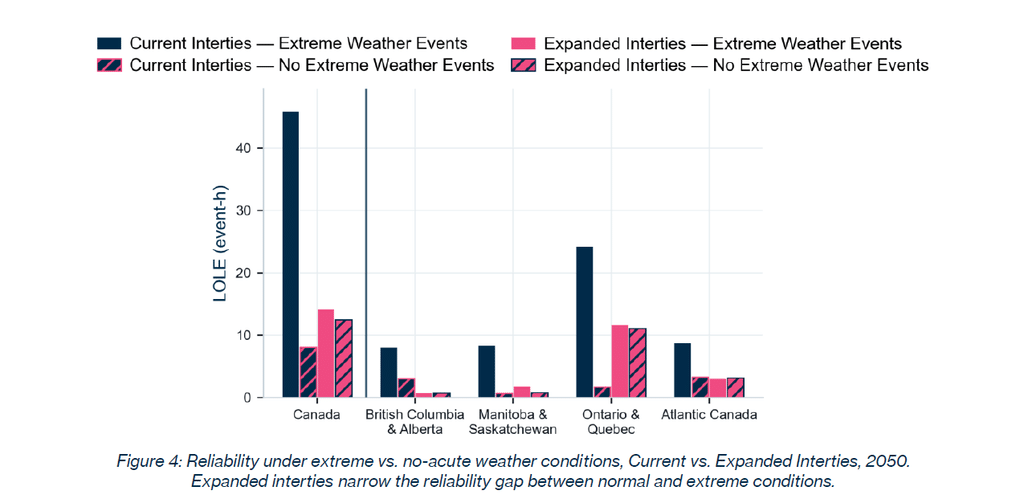
Across all four corridors, expanded interties consistently improve reliability while lowering net system costs. Nationally, building out interties reduces the expected frequency of outages under extreme weather by 69%. The improvement is largest where a province can lean on a neighbour with a complementary generation mix. The expected outage frequency falls by 92% in British Columbia (drawing on Alberta’s thermal and wind resources), by 78% in Saskatchewan, and by 90% in Ontario (drawing on Quebec’s wind and hydro). At the corridor level, region-wide LOLE falls by 52% in Ontario-Quebec and by 66% across the Atlantic provinces. Interties also make the grid more weather-resilient because weather shocks are localized and provincial generation mixes differ. Connections allow the system to draw on whichever supply is least affected at any moment, narrowing the reliability gap between normal and extreme conditions (Figure 3 & Figure 4).