Chadi M. Mourad Discusses ABB’s Partnership with Bruce Power to Modernize Excitation Systems
July 23, 2026
By Blake Marchand
Earlier this year, Bruce Power announced they signed multi-year contracts with ABB to supply advanced excitation technology that will help extend the life, reliability and efficiency of Bruce Power’s eight operating units.
In this article we talk to Chadi M. Mourad, ABB’s North American Sales Manager for Power Reliability about the partnership and unpack the significance for ABB from his perspective.
“It’s quite intense, quite heavy, very thorough,” Mourad said about the procurement process. “A lot of collaborative conversations that took place, being close proximity to them helped us in this in this project. And ultimately, we came up with a design and an offer for them that that they chose to be satisfactory. We’re quite happy about that.”
Mourad emphasized the importance of their experience in being selected by Bruce Power for the project, their UNITROL systems are installed in over half of nuclear facilities in North America.
Currently, the project is several months in, deep into the design, and moving forward with what will be a multi-year project/partnership.
The project is an engineered solution, so a large part of the process will be the engineering portion. After that the equipment will be manufactured. Once the engineering and manufacturing is complete, there will be a testing phase, “which is quite extensive,” Mourad noted.
Then ABB will work with Bruce Power to train staff on the systems and once the equipment is supplied, Bruce Power will begin integration, which involves engineering on Bruce Power’s side of things, the old system needs to be removed before moving into the commissioning phase for the new system.
What makes a project like this successful is expertise, collaboration and partnership. The teams of ABB and Bruce Power established a strong working relationship that will continue to evolve throughout the project.
“It takes teams on both sides to make this happen,” Mourad rightly points out. “Super proud of our team, but also appreciative of Bruce Powers’ team.”
“The engineering teams and commercial teams coming together to put together this complex multi-year project is not easy, and it took a lot of collaboration.”
With that type of mindset, one of continued progression, healthy collaboration can’t be overlooked. It is through these types of complex projects that organizations like ABB and Bruce Power –both with a long history of expertise and innovation– can continue pushing forward, improving upon their already robust processes.
Efficiency & Eliminating Single Points of Vulnerability
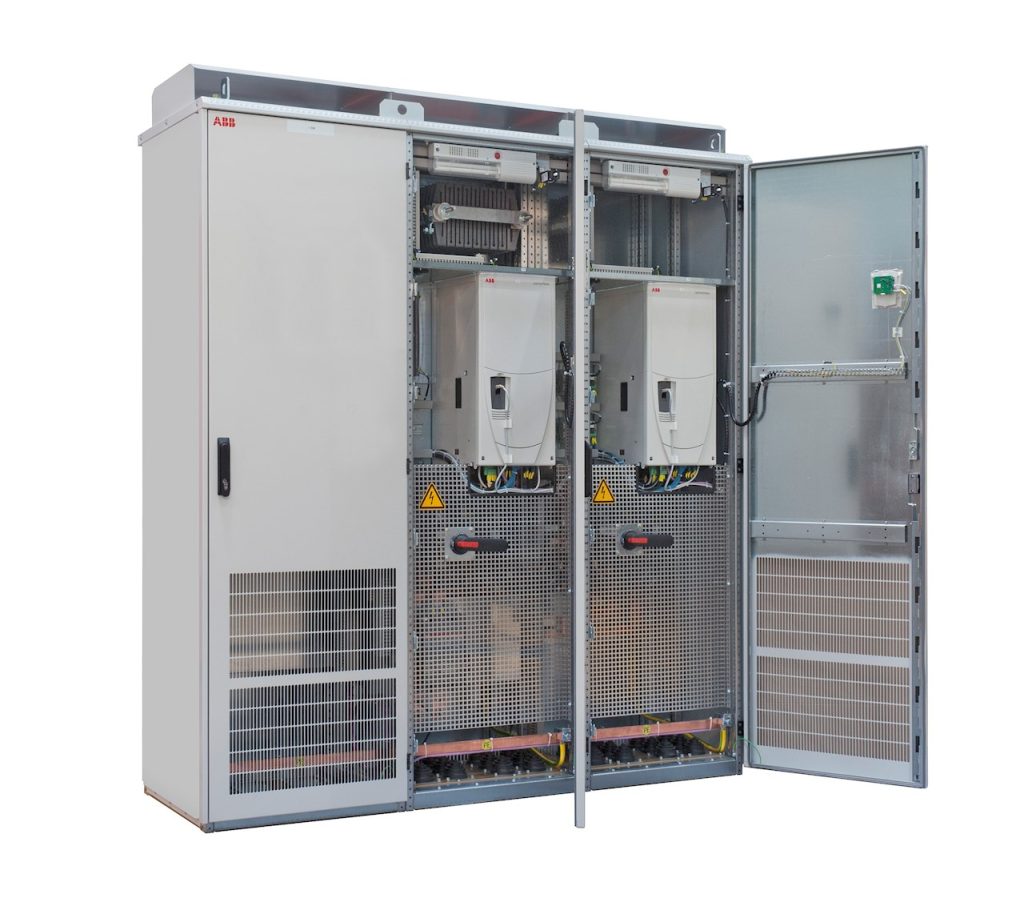
Mourad highlighted ABB’s ability to facilitate efficient and reliable power generation with their UNITROL solution. A key aspect of that is eliminating single points of vulnerability.
“What that means is it’s a very, very reliable, highly redundant system,” Mourad said.
Excitation systems control the output of the generator itself. It controls the energy contributing to the stability of the electrical grid, it ensures that the generator is available and able to produce power, Mourad explained.
“If you don’t have the excitation system, you cannot generate electricity. It’s actually a very critical asset. It goes hand in hand with the ability of the generator to produce power.”
I asked Mourad to unpack how they are able to eliminate single points of vulnerability:
“You have a core processor that’s taking millions of decisions per second and deciding how to fire the thyristors to actually produce the current that’s needed to feed the generator. That’s what the exciter does. It’s feeding current into the generator.
So, this computer, essentially is running all these calculations… If that computer fails, what do you do? Well, what we do is have a backup.
It’s actually running in parallel, equally tested of high, high quality, of course, but also the design is the same with the single points of vulnerability.”
Mourad added that if it fails, “it simply goes to the next one and you don’t even know it’s happening because they’re running in parallel.
“It’s called a hot standby that’s on the control side, but it’s also a power system. With the exciter system, you have the control side, which has the redundancy– but then on the power side, you need that same redundancy.”
Given the critical nature of the system to power generation, Mourad said you can’t have it be down for days at time to address some kind of failure.
“If anything in that chain fails, you have to be able to back up on the next one.”
Critical Infrastructure, Canadian Connection
Canada has long history of innovation in nuclear energy dating back to 1944 when research began on what would become the Candu reactor.
ABB’s Canadian roots are strong. They have more than 3,300 employees at 33 locations across the country, including eight offices in Ontario, and their Saint-Laurent headquarters, as well as offices in Alberta, BC, and Nova Scotia.
“It’s in our home,” Mourad said of the project, “and having a Canadian customer/partner with us was also a big deal,” he said.
“A project like this gives us base load work for years to come. It’s solid for Ontario’s job market and for ours, as well.”
Mourad doesn’t underestimate the importance of a critical project for critical infrastructure.
“On a personal level, it’s a career highlight, but for the team and for the business, it’s quite strategic and right within what we’re trying to focus on and build, so it’s super good momentum and what we’re building.”
“We’re not new to this, but we’re constantly pushing to get to get better,” he said. A project like the one with Bruce Power provides the right type of challenge for both organizations to push the electrification transition forward.
The province of Ontario has continued to lean into nuclear generation, while other provinces are beginning to explore adding small modular reactors (SMRs) to their energy mix.
“It’s not every day that you’ll see a new nuclear power facility being built. It’s quite complex and it takes decades at times,” Mourad noted, “But small modular reactors are becoming part of a bigger discussion to have distributed energy.”
“Also, what you’re seeing is that the existing infrastructure has to get modernized,” Mourad emphasized the importance of making our existing systems more robust and increasing efficiency.
Bruce Power Background
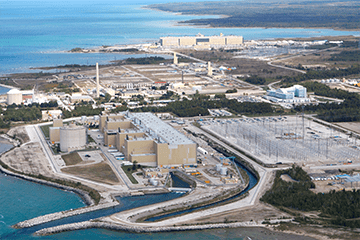
Bruce A & B have an installed capacity of 6,232 MW.
In 2021, Bruce Power announced a plan to increase the site’s generation peak to 7,000 MW.
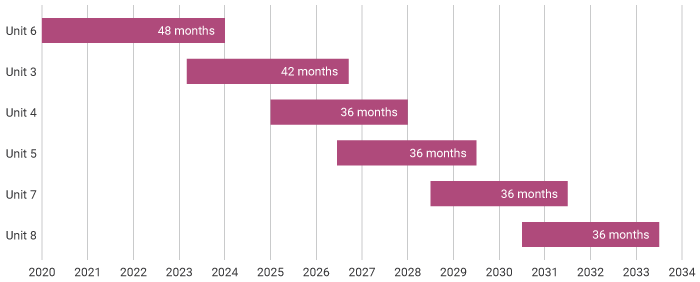
Bruce Power completed the first Major Component Replacement (MCR) Project, Unit 6 in 2023, renewing the unit ahead of schedule. In February of this year, the construction phase was completed for their Unit 3 MCR. They are now working on returning the refurbished unit to service. Unit 4 was taken offline in 2025 to begin its three-year refurbishment.
Bruce Power continues to provide approximately one-third of its output (2400 MW) as flexible generation, which allows the province to balance system needs. The World Nuclear Association notes that, “this is a feature that only the Bruce Power units can provide and has been used frequently by the IESO since 2009.”
The IESO approved the Unit 5 MCR project in April of last year.
Canadian Nuclear Energy Picture
Across the country, nuclear accounts for 14-15% of Canada’s energy mix (as of 2024). There are 17 operable reactors totaling 12,714 MWe and 8 reactor shutdown representing 3,181MWe, according to the World Nuclear Association.
In Ontario, nuclear accounts for 32% of the provinces energy mix, the largest single component followed by gas (28%) and hydro (23%), as of December 2025.
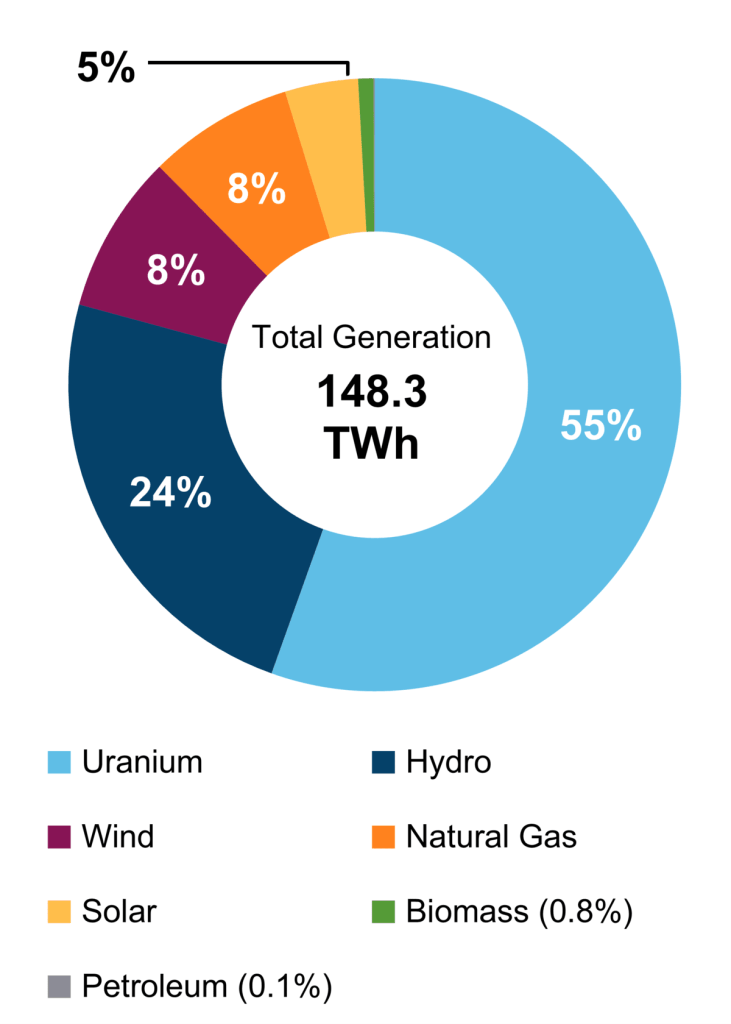
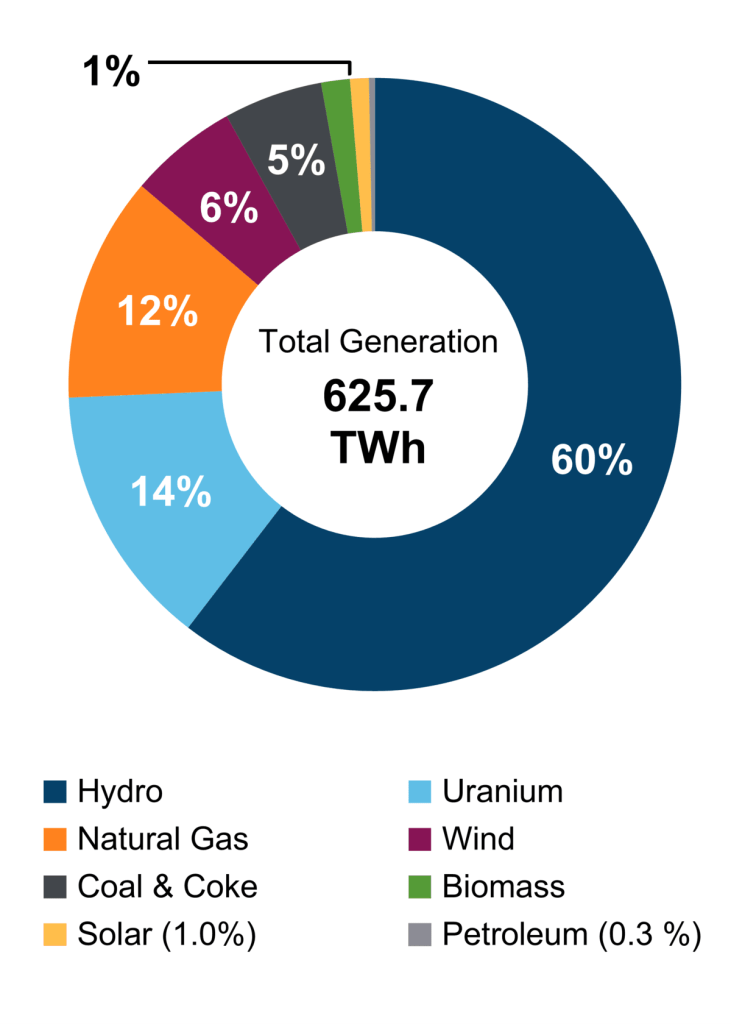
The 17 reactors are Bruce Power 1-8, Darlington 1-4, Pickering 5-8, and the Point Lepreau Nuclear Generating Station in New Brunswick.
In 2022, Alberta, Ontario, Saskatchewan, and New Brunswick jointly released a Strategic Plan in 2022 for the deployment of SMRs. Since then, Ontario Power Generation began refurbishing their Pickering station. In 2024, OPG began engagement to examine the feasibility of developing SMRs in Alberta. New Brunswick and Ontario signed a nuclear support agreement in November 2025, aimed at driving performance at the Point Lepreau Nuclear Generating Station. In February of this year SaskPower announced plans to evaluate the deployment of large nuclear reactor technologies in Saskatchewan.
At the same time Ontario is exploring opportunities to leverage their nuclear expertise abroad with agreements in Romania, France, Poland, and Estonia.